
Cinema from the North East foregrounds discursive gaps between lived Indigenous practices and non-Indigenous reception of the same, as well as directs our attention to the growth and development of new ways of understanding the world from the perspective of Indigenous discourses. Jyotiprasad Aggarwala’s Joymoti, the story of the Ahom princess who sacrifices her life for democracy, was released in 1935. Combating the neo-imperial presence of institutionalised studios in Bombay and Kolkata, Aggarwala wrote: “In India, Indian films must be made…otherwise it would be impossible to put an end to the suction of money by foreign films…For sometime, the Assamese people, instead of comparing an Assamese production with Bengali, Hindi or American films, must take an Assamese film eagerly and endearingly as one belonging to the first grade despite its lack of quality if there be any.” (cited in Mazid 2007: 37-8)[1]. Aggarwala would return to Assam after training in Germany’s UFA studios to establish the Chitralekha Moviestone Company at Bholaguri Tea Estate in Assam. People involved for the movie production belonged to village communities in the region. However, despite the long and complex multilingual history of cinema from the North East, one seems to remember only a Pramathesh Barua,a S.D. Burman, a Bhupen Hazarika, or a Seema Biswas as scattered names from the North East pantheon. What is forgotten is the conscious, continual process of ‘de-territorialising diversities’, closely connected to the concept of bringing to the centre the fluid cultural borders and boundaries and ‘closed’ spaces”[2].
Mishing, Karbi, Kokborok, Bodo, Manipuri, Assamese are just some of the languages in which North East cinema has been made. Complex cinematic texts connect the political and the public, moving beyond the mainstream media discourse on insurgency and military intervention.
For instance, AFSPA, 1958 written and directed by Haobam Pebam Kumar in 2006, is a documentary movie, which focuses on the plight of women from Manipur in the aftermath of the Manorama Devi AFSPA episode. On 10 July 2004, Thangjam Manorama had been picked up from her home in Bamon Kampu Village in Imphal East District by the 17thAssam Rifles on the basis of her alleged connections with the People’s Liberation Army. The next morning, her bullet-ridden corpse was found along with semen marks on her skirt suggesting rape and murder. It led to widespread protests and a group of women belonging to the “Meira Paibi” or “Torchbearers” demonstrated in front of the 17th Assam Rifles by stripping naked and calling on the army to rape them as Manorama had been raped. AFSPA, 1958 offers a sustained and poignant diary of the events of 10th July 2004 and its consequences which highlight failure of justice and the controversies around AFSPA.
The deprivation of land, forced migration and the eradication of Indigenous ways of life have been integral to narratives from the region. Joseph Pulinthanath, with his origins in Kerala, has spent much of his time in the North East. In 2008, he made his second feature film in the Kokborok language entitled Yarwng or Roots. Located in the idyllic banks of the Raima and the Saima, the movie revolves around a Hydel Project in Tripura in the 1970s, which led to a large-scale displacement of Indigenous peoples. While the film is emphatic on the erasure of Indigenous identity, Soumitra Debbarma, a researcher in History from Tripura University, feels:
“Sadly, there is hardly any audience for such films as Indigenous youth seem to be increasingly assimilated within so called main stream cultures, ignoring our sense of history and culture. Such films need to be watched within Tripura in order to initiate the process of healing and also beyond Tripura in order to overcome stereotypes and rethink epistemological assumptions.”
Manju Borah has directed eight movies in Assamese, Mishing and Bodo and has also received several international and national awards. However, for her last film entitled Dau Huduni Methai (Song of the Horned Owl, 2015) based on the effect of Bodo insurgencies on villagers, Borah expressed her apprehensions: “I don’t think it will ever have a theatrical release. With most theatres favouring mainstream cinema and even audiences, it’s impossible for films from other languages to make it to cinemas…. It’s really sad that only Hindi and English films manage to enjoy theatrical release. What about other language films? We produce films in so many languages but why the focus is always on Bollywood?”[3] Borah’s 2012 film Ko: Yad (A Silent Way) in Mishing revolves around the life of Pokkam from the Mishing community. Based on Anil Panging’s novel Ko: Yad that was published in installments in the weekly Assamese daily Xadin, the movie won the Best Assamese Mishing Film Award along with the Best Cinematographer award for Sudheer Palsane at the 60th National Film Festival in 2012. The story of a driftwood collector and the betrayal that he faces from his family, creditors and the river itself is emblematic of the human condition.
“Returning home” is a significant trope of much of contemporary films from the North East, given the pains of alienation, exile and a diminishing sense of ‘homeland’. It becomes crucial to be able to return to the geographical space of the homeland, before one can enter the process of reclaiming identities and attempt a completion of performance. Crossing Bridges (2013) directed by Sange Dorjee Thondok is the first feature film in Shertukpen, one of the languages of Arunachal Pradesh. The movie tells the story of middle aged Tashi, who returns to his village after losing his job as a web designer in Mumbai. In the long wait for new openings in the city, Tashi experiences the worldviews of his people, which changes his perception of life and aspirations. In an interview, Thondok, a graduate from the Satyajit Ray Film and Television Institute, Kolkata, asserts that to make a film in Shertukpen was a conscious decision and he also divulges “but I didn’t have the fear of it not reaching the audience as the basic idea of making the film in my language was to preserve it in whatever small way and at the same time show rest of the world, which knows very little about our culture and way of living.”[4] Tashi, the protagonist, would like to ‘get out’ of home, which he feels does not have anything to offer. Yet, through his days of unemployment, he connects, albeit unwillingly with his ageing parents, friends, and children at a school where he decides to teach for a while. He realises that for them, Mumbai is ‘foreign land’, while for him, his village and its people have become ‘foreign’. Yet, he is haunted by remarks and questions like “You seemed to have lost our taste for butter tea”, or “Why don’t the outside world know about us?” The movie is a beautiful kaleidoscope of little surprises in the pristine valleys of Arunachal Pradesh, yet rooted in real questions on how important it is to “stay back”.
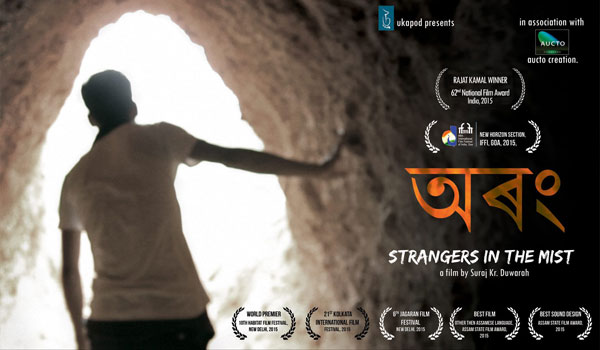
Orong directed by Suraj Kumar Duwarah won the Best Feature Film Award in Rabha at the 62nd National Film Festival. The story of the teenager Rasong and his struggle to live life in his own terms may be juxtaposed with that of the elderly Apu, a former ‘head hunter’ and his travails in the dense forests of Nagaland, in Nilanjan Dutta’s The Head Hunter (2015) in the Wancho language.
Films from the North East involve going back in history and also engage in a continuous negotiation with contemporary forces, such as globalisation, neoimperialism, and power politics within Indigenous communities.
Directors from the North East are establishing a new path of Indian film production. Through a lyrical use of nature and locations, and a discussion of hard-hitting issues pertinent to the region, they weave tales of wonder and woe, producing profound art, which ‘returns’ the gaze.
Citations:
[1] https://montymajeed2.wordpress.com/2014/09/30/121-interview-sange-dorjee-thongdok/ Accessed on 22 July, 2016.
[2] http://indianexpress.com/article/entertainment/regional/dont-think-my-film-will-make-it-to-theatres-manju-borah/ Accessed on 22 July, 2016
[3]Mazid. A. “Jyotiprasad and Joymoti:The Pioneer and the First Assamese Film” in Barpujari M. and Kalita G. Eds. Perspectives on Cinema of Assam. 2007. Guwahati: Gauhati Cine Club, 29-50
[4]. Prem Kumari Srivastava and Gitanjali Chawla. Eds. De-territorialising Diversities: Literatures of the Indigenous and Marginalised. 2014. New Delhi: Authorspress, 21.


soxo66app
Just downloaded the soxo66app. Seems pretty slick! Hopefully it pays out better than my last punt. Wish me luck, lads!
quick win casino bonus code
Dort finden Sie exklusive Turniere oder Cashback Boni, mit denen Sie eine
zweite Chance in den Casinospielen Ihrer Wahl erhalten können. Profitieren Sie zusätzlich von Woo casino 25 freispiele und erhalten Sie den vollen Nervenkitzel eines
Live-Casinos. Sie konkurrieren um die besten Preise, indem Sie einfach Ihre Lieblings
spielautomaten spielen. Im Gegenzug erhalten Sie
Zugang zu den besten Angeboten und haben noch einen weiteren Grund, in diesem Casino zu spielen.
Die Glücksspieler aus Deutschland erhalten Zugang zu über 300+
neuesten Spielautomaten, professionellen Bewertungen sowie zuverlässigen und unvoreingenommenen Bewertungen zahlreicher internationaler Casinos.
CasinoSpot.de ist eine Online Casino Website, die Bewertungen über die Glücksspielindustrie und eine umfangreiche Sammlung von Glücksspielen und Spielautomaten bietet.
Entdecken Sie das aufregende Universum von Slots, Tischspielen und weiteren mit speziellen Deals,
die für Woo casino Spieler maßgeschneidert sind! Profitieren Sie von lukrativen Einzahlungsboni, exklusivem Cashback sowie dem Nervenkitzel von Freispielen und speziellen Aktionen. Mit
einer breiten Palette an Slots, Tischspielen und Live-Dealer-Spielen liefert Woo casino
nicht nur Spannung, sondern auch absolute Sicherheit dank seiner Lizenzierung
und Regulierung. Was mir an Woo besonders gefällt, sind die vielen verschiedenen Boni, vor allem der großzügige Willkommensbonus mit Freispielen. Das hilft ihnen, mit der
Möglichkeit zu spielen, die höchsten Auszahlungen zu erreichen, oder einfach mit höheren Gewinnen zu starten.
Aktivieren Sie einfach den Bonuscode WOLF während der zweiten Einzahlung, um den zweiten Bonus zu
erhalten. Es besteht sogar die Möglichkeit, nach der ersten Anmeldung gleich einen ersten Willkommensbonus zu erhalten.
Das Casino bietet eine klare und übersichtliche Website mit einer Spielauswahl, die seinesgleichen sucht.
Diese seriöse Lizenz gibt den Spielern die Gewissheit,
dass sie in einer sicheren und vertrauenswürdigen Spielumgebung spielen.
Und für die Wochenenden bereiten Sie sich darauf vor, mit
einem 50% Bonus bis zu 100 € sowie 60 Freispielen wieder aufzuladen, wenn Sie den Code RELOAD verwenden.
References:
https://online-spielhallen.de/jackpot-de-slots-casino-deutschland-dein-ultimativer-guide-fur-kostenlosen-spielspas/
online casino australia 2026
Exclusive high-limit gaming with premium VIP treatment
Your ultimate destination for high-stakes gaming and big wins Yes, Royal Reels 5 is fully optimized
for mobile devices.
Sign up at Royal Reels, grab your free chip, and discover why
we are the number one choice for real money gaming down under!
If something’s not quite right — from a game round error to a payout question — reach us via Live Chat or
the Contact page and we’ll look into it with you.
Earn XP as you play, then convert your points to real funds from the V.I.P section of
your profile.
Royal Reels has made sure that Aussie players can enjoy
top-tier gaming from any device – whether you’re using an Android phone, an iPhone,
or even a tablet. Just clear bonuses, a wide range of pokies, and helpful support if you ever
need a hand. With a smooth design, generous promotions, and fast payouts, it’s built for players who want real entertainment with real rewards.
Yes, Royal Reels Casino regularly updates
its game library with new titles from top industry developers to ensure fresh gaming experiences.
Royal Reels Casino is committed to responsible gaming by offering tools like self-exclusion options, deposit limits, and access
to professional help organizations to ensure a healthy gaming environment.
References:
https://blackcoin.co/stake-casino-australia-where-online-thrills-begin/
Casino NSW local shopping
The first and second phases of construction employ
a fire protection system in parts of the building.
A matching porphyry dwarf wall adjoins the
building on some elevations surmounted by a wrought iron fence.
The building is faced with sandstone ashlar except for the inner walls of the
arcade.
Finding a good site for QLD players is also about securing the best welcome bonuses too.
We have some top recommendations for QLD players like you.
And if you’re playing at an overseas gaming site,
it’s vital to check they have the proper licensing in place and security to die for.
The 2001 Interactive Gambling Act prohibits unlicensed gaming sites from operating in Australia.
The front elevation of the third section differed only slightly from Clark’s original concept, although structurally and in internal materials and fittings it was a 1920s building.
The Registrar-General’s building was demolished late 1922/early 1923, and construction commenced in mid-1923,
using day labour. In 1874, a single-storeyed building for the Registrar-General was erected on the corner
of George and Queen Streets, anticipating a government re development
of what had become known as Treasury Square.
References:
https://blackcoin.co/instant-withdrawal-casinos-australia-15-fast-payout-casino-sites/
www.vytega.com
australian online casinos that accept paypal
References:
http://www.vytega.com