
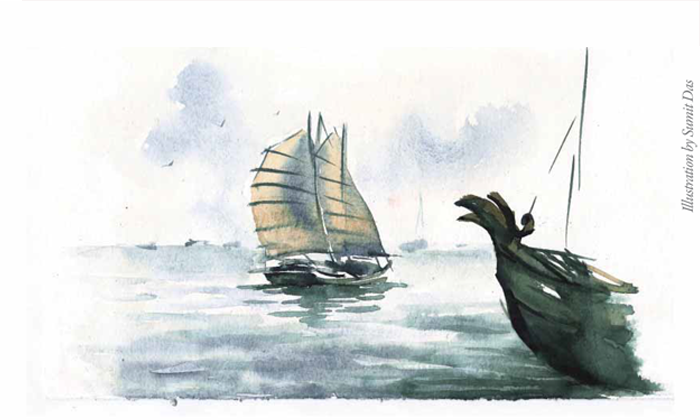
At the Phnom Penh airport in Cambodia, I waited for flight VN818 to Saigon; ‘Homeward Bound’ by Simon & Garfunkel, playing on my headphones and I was reading ‘The Lost Steps’ by Alejo Carpentier. Light slanted on the granite tiles of the shiny airport floors. Passengers rushed about. I had no phone, so I sat there with a million thoughts in my head. Soon, I was in Saigon.
Saigon is a well-known older name for Ho Chi Minh City (HCMC), it was renamed after Ho Chi Minh, the revolutionary warrior of Vietnam; a country that has seen such strife that it has become engraved in world (and especially American) memory with the association of a war.
HCMC is a large bustling city, a commercial centre, a port, and a curious mix of the old and new. Along the plazas, the business hubs, the luxury outlets, lie the narrow alleys of old town, where one walks past families sitting on the floor watching TV together, playing games, or the small cafes where people are huddled, watching ‘Star World’.
One might observe many remarkable things in HCMC; the sheer energy of the place is overwhelming! But, nothing is more central than this fact — If you can cross roads in Saigon, you can cross roads anywhere in the world.
The most striking aspect of negotiating the city is dealing with its traffic: a raging storm of vehicles of all kinds. There must be tens of thousands of motorbikes in the city. On some of the big broad avenues, the flow of traffic is such that one would cower crossing even at an intersection! At rush hour, the bikes are not only on the roads but on the pavements too, and often in contra flow directions. I have navigated much unruly and/or abundant traffic on streets in Indian cities, so I was no novice. But, HCMC traffic is just something extraordinary.
“There was some thought-provoking graffiti in a construction yard, questioning the concept of security: human versus the privatised. I remember walking through the rubble of a demolished building that might once have been a house or a cafe.”
One evening after a long day of walking, I waited for over ten minutes to cross one road, then gave up and sat on a parapet beside a tree as I cursed the Sunsilk advertisement featuring Marilyn Monroe on a billboard for being on the other side, and my ineptitude at handling my camera settings which would not let me capture her image, except as a white blob. On another occasion, I bought something from a woman who sold noodles at a pavement stall, solely to request her to assist me in crossing the crazy boulevard. She held my hand and helped me cross, genially indicating that she thought my long, pierced nose strange, though beautiful. ‘Didn’t the piercing hurt?’ she wondered.
Many times on these busy thoroughfares, I inwardly assured myself that I wasn’t, after all, going to die crossing a road in Vietnam. Yet, the thoughtful and the thoughtless are equal before the gods of traffic-death; Roland Barthes, the semiotician and philosopher, was run over by a laundry van in Paris. I saw a minor accident involving a young Vietnamese woman, but noted too that there were helpful people around.
HCM city is divided into numbered districts. The area around the Pham Ngu Lao street is where the foreign travellers are on a budget stay. It is not that far from the main sights – to name some, the grand official buildings of the Reunification Palace, the People’s Committee Hall, the Notre Dame Cathedral, the Revolutionary Museum, the War Remnants Museum, the Saigon River, the covered Ben Thanh Market. So, in seeing these places, the tourists see the communist monuments, the building where ‘McCain was once a prisoner’, the museum where horrors of previous wars are condemned and the bravery of the resistance is celebrated, and the park with large book exhibits and so on.
The immediate surrounding of this touristy street has many alleys with small exotically named hotels, hostels and shops (a hotel run by a couple of Vietnamese women is called ‘Blue Mango’, then there is a shop called ‘Far Far Away’, you get the idea), and the area is bustling in the summer evenings but has a different atmosphere in the afternoons when the sightseers are out exploring. Out to get food in the evening, I evidently appeared foreign enough for a local woman to ask me to verify 50 Swiss Francs that some man had given her for laundry payment. And for a small boy to come behind, offering to sell me cigarettes. When I refused, he opened up a false bottom layer of his sling display case and showed me some brownish stuff muttering something, of which I caught the word ‘opium’ at the end. ‘No, I’m really fine’, I said more firmly and he left me alone. I am nowhere near as experimental as my silver shoes with denim, and orange and green clothes might suggest!
I soaked in the ambience of afternoon on another day. It was overcast and I woke late, feeling a little like Rip Van Winkle, fearing that I might have slept an entire day in between, as a result of being tired from all the walking of the day before. It was past noon, I stood at the window of my room which overlooked a tiny alley with some view of the sky above. I liked the wind in my hair, the swaying reflections on the dark surface of the coffee in my hand. And music played…an unsorted shuffle of Fado, Radiohead, Norah Jones, even Matt Monroe. The bells of an ice cream and bun seller tinkled below the multi-coloured houses opposite – their balconies were about 20 feet away. A dirty rolled-up Vietnamese Communist flag hung on one of them. Sparrows jumped ledges. One was determinedly picking at a speck, mistaking a bit of plaster for grain. Most people were out and away from these guesthouses into the city. A red paper lantern hung dusty and cracked. One building had a rooftop garden with plants including palms. Sounds and sights merged into a symphony, only partly visible. There was the sound of chirping, tapping on wood, honks of motorbikes and sounds from the contraption in their hands used by cyclists without bells, a phone ringing, the raised interrogative sound of a child’s words, wind rustling through the faded and drooping curtains, ‘Welcome’ doormats lying askew on polished floors down below, those conical hats worn by migrant sellers from Hanoi, biker helmets, the neon hotel signs now switched off, bamboo shoots, a bright yellow clothes rack. I stood there a long time. Why, through its stories of wise male prophets and divine women mystics, is the renunciation of the world associated with an achievement of enlightenment for men but ecstasy for women? The famous Egyptian singer Oum Kolthoum (or Umm Kulthum) was now singing the classic Fakkarouni behind me; she was a legend of Arab music. I looked up. And the ever amazing mad birds (swifts? swallows?) were dancing to their tunes in the sky. It was a kind of happiness. I was a scene from a movie, a character from a book. My life a poem, I crafted its rhythm. I was alive. It was companionable solitude.
When I ventured out that day, it was to Chinatown (Cholon) and the riverside. There was much to wonder about, in some of the poorer areas of Chinatown. Why was the social mandate of Communism so different outside the West? Why was it not incumbent for the Communist State to construct an equivalent of the social housing Panelak complexes of Eastern European countries? At one point, I needed directions, and thought of stepping into a police station, but my charming lost persona was met with a generally surly uncommunicativeness. In contrast to which, some young people in a rather deprived area (the kind that a tourist would probably not know, but a wanderer may reach) were enormously friendly and warm.
I rambled through many parts of the city. There were fashion shops with gorgeous western clothes and beautiful Ao Dais (the Vietnamese national costume for women is an Ao Dai, a kind of long fitting tunic and loose trousers) next to the homes of the poor, the homeless sheltering under a smartly lit advert shade. There were the sellers from Hanoi and the countryside, wearing conical hats in the summer heat and carrying coconuts and much else on large scales that were balanced on their shoulders with a bamboo pole. As in China, such workers were mostly averse to being pictured by tourists and often hid their faces. I imagine this is something beyond mere personal choice, probably involving the legal/bureaucratic awareness of migrant workers too. I saw two policemen on bikes waving batons to shoo the crowd aside as they blasted their way near Diamond Plaza.
There was some thought-provoking graffiti in a construction yard, questioning the concept of security: human versus the privatised. I remember walking through the rubble of a demolished building that might once have been a house or a cafe. Some of the outer walls were still standing and one could see marks where stairways and windows could have been. Further up the remnant part of the wall, on what would once have been the first floor of the building, was a painting done in white and brown on the pink wall – it was still exactly as it would have been when the building existed. It depicted a snow-covered arched passageway of trees. It seemed so serene and contextless amid the ruins that one had to pause and reflect on the miracles of time.
There is poetry in everyday street life. A pile of swept-up dust in a lane near Saigon Railway Station had a loose pack of cards – how the card faces peeped up: Queen, Jack and Ace! I often stopped to take pictures of randomness and sometimes people would pose with their babies and ask me to photograph them. In passing, suddenly in a narrow – so narrow – alley, a child would smile and wave from a mother’s lap, or flick on the beam of his little toyride. There are no strangers in this world. The very concept of ‘a stranger’ merely connotes someone you haven’t involved with yourself.
Before I left HCM, I was given a music CD by a Vietnamese who I had once known as a student. I didn’t know him much in England (we had spoken on a few occasions, mostly about music), and it had been years since, but when I e-mailed to say hello, he insisted on hospitality involving a meal and the gift of music. And so I have the fabulous ‘Bóng Thời Gian’ (The Shadow of Time) by Trần Mạnh Tuấn. I haven’t communicated with him since (I shall pass the kindness forward someday to a visitor somewhere I am), but I cherish the soulful jazz music and it has accompanied me to many sunsets.
The next morning, it rained. I left for Hanoi.


Spirit Casino sicher
In ähnlicher Weise ist das Feedback zum Barservice unterschiedlich;
einige Gäste loben die Aufmerksamkeit und Freundlichkeit
des Barpersonals, während andere aufgrund des wahrgenommenen Personalmangels einen langsamen Service
feststellen. Während der Check-in-Prozess in der Regel reibungslos verläuft, berichten einige
Gäste von gemischten Erfahrungen mit dem Rezeptionspersonal, das sie gelegentlich als gleichgültig oder wenig hilfsbereit empfanden. Das Housekeeping-Team wird oft als effizient und gründlich
beschrieben, wodurch sichergestellt wird, dass die Zimmer
sauber gehalten werden. Personal & ServiceDas Hotelpersonal erhält im Allgemeinen positives Feedback, wobei viele Gäste das freundliche
Personal, das hilfsbereite Personal und den professionellen Service loben.
Für diejenigen, die sich sportlich betätigen möchten, steht ein mit modernen Geräten ausgestatteter Fitnessraum
zur Verfügung. Der Entspannungsbereich umfasst einen Jacuzzi, ein türkisches Bad
und eine Sauna, die einen kompletten Raum zur Erneuerung von Körper und Geist bieten. Die elegante
und moderne Atmosphäre des Casinos in Verbindung mit den lebhaften Aktivitäten machen es zu
einer unumgänglichen Attraktion. Silvester ist eines der Ereignisse des Jahres, für
das Madeira weltweit bekannt ist. Oder nehmen Sie es beim Schwimmen mit den Wellen des Atlantiks
auf. Erkunden Sie Madeira bei Wanderungen entlang fantastischer
Wasserströme und wunderschöner Pfade.
References:
https://online-spielhallen.de/drip-casino-aktionscode-ihr-schlussel-zu-besonderen-vorteilen/
Dining at The Star Sydney
Although the casino is less spacious compared to some of the other
venues in Queensland, it still has a lot to offer. Besides,
you can take part in tournaments that a casino regularly runs.
You can spend several days in a casino in Queensland and book cozy accommodation at an earthy price.
A good thing about Treasury Casino and Hotel is that it is a perfect place for gambling travelers.
The taxes levied on gambling operators depend on the state where the gambling company operates.
When reading the terms laid by a no deposit casino Australia, you might
come across the following, which you need to focus on. The terms and conditions of an Australian casino with sign-up bonus are
usually different from one another, but in some cases, they are similar.
Like every other free spin online bonus, these rewards can only be used in one slot
machine, and Hexabet chose the Gates of Olympus 1000 slot.
References:
https://blackcoin.co/are-bitcoin-casinos-better-than-normal-casinos/
safe high paying casinos Australia
Enjoy the online casino experience without
the risk, simply play for fun! You can play Caesars Slots in a wide variety of locations including iOS, Android, caesarsgames.com, Facebook,
and more! They work similarly to real casino slots, where a player spins the reels in hopes to win the betting line.
Make planning easy with this guide to all the must-see vistas, must-eat dishes and must-experience attractions.
Educating users about the benefits and risks of automated financial solutions is crucial for widespread adoption. Compliance with existing and future regulations poses a
challenge for automated financial solutions. Additionally, over-reliance on historical data may not account for future market anomalies.
All transactions and portfolio adjustments
are recorded on the blockchain, providing an auditable trail.
Automated systems can continuously monitor portfolios and implement risk management strategies to protect against market volatility.
Advanced algorithms can analyze vast amounts of data and execute trades based on real-time market conditions.
But for entry-level investors, digital advisors allow you to break into the market,
requiring an average minimum account investment of just $500.
Promising minimal fees and slick mobile apps, online robo-advisor
services offer a hands-off approach to portfolio management.
However, by taking the time to reflect on your investment goals and your needs, you
can decide if a robo-advisor is appropriate for your investment journey.
They may not replace traditional advisors for complex financial planning,
but they’re a great solution for newcomers, fee-sensitive investors, and anyone who wants a
more simplified approach to investing.
References:
https://blackcoin.co/how-to-play-the-big-red-pokies-the-kiwi-way/
divyangrojgar.com
online casino real money paypal
References:
divyangrojgar.com