
Over the last two decades, roughly coinciding with the period of economic liberalization, there has been a dramatic transformation of India’s ‘mediascape’ – a term first used by Arjun Appadurai, an academic of Indian origin based in the US, to describe the way the visual imagery impacts the world and to describe and situate the role of the mass media in global cultural flows. With the advent of new communication technologies and the burgeoning of urban middle classes whose consumerist aspirations made them targets for advertisers, the mass media in India expanded like never before, that is, until the economic slowdown started from 2008 onwards.
“But media offerings or the products and services of cultural industries are different in an important sense. Quantity has not translated into quality.”
In this environment, small publications and television channels have been pushed to the margins. Whereas the internet and community radio stations offer some hope for the future, media offerings aimed at the underprivileged, especially the rural poor, are finding it increasingly difficult to survive (leave alone, prosper) despite a few notable exceptions – one of which has been profiled at the end of this article.
India has the largest number of newspapers/publications in comparison with any country in the world. There are over 72,000 publications currently registered with the Registrar of Newspapers of India. According to ‘The Economist’ (July 7, 2011), India is now the fastest growing and biggest newspaper market in the world having overtaken China to become the leader in “paid-for” daily circulation of newspapers: at least 110 million copies are sold each day. Though there are no precise statistics available, one could guess that less than 200 publications will account for over two-thirds (perhaps, over three-fourths) of the total quantum of paper consumed by the entire print medium in the country.
The number of radio stations using the frequency modulation (FM) broadcasting mode has gone up exponentially and will go up further – from over 250 now to around 1,200 in the next five years. Yet, paradoxically, India is the only democracy in the world where news and current affairs programmes on the radio remain a monopoly of a government-owned and controlled body (All India Radio) which is ostensibly “autonomous”. Still, AIR remains a unique organisation of its kind, producing programmes in more languages and dialects than any other radio broadcaster in the world
While nobody has an accurate estimate of the number of internet websites catering to Indian users, the growth in the number of television channels in the country has been truly unprecedented – not just here in India but perhaps anywhere in the world. From one public broadcaster, ‘Doordarshan’, in 1991, at present, over 700 television channels have been permitted by the Union Ministry of Information & Broadcasting to uplink or downlink from the country, of which roughly half fall into the “news and current affairs” category (even if many would disagree that stories about ghosts spotted in haunted houses and weddings of snakes constitute “news”).
But media offerings or the products and services of cultural industries are different in an important sense. Quantity has not translated into quality. Defying conventional norms of capitalism, the intensification of competition in the media has been accompanied by a discernible lowering of ethical standards. The race to grab eyeballs has seen a simultaneous “dumbing down” of content as television channels have become prisoners of a highly-inadequate and flawed system of ascertaining audience sizes through TRPs (or television rating points). Sections of the print medium too have imbibed some of the worst practices followed by some of the more crass television channels.
The concentration of media ownership in the hands of large corporate groups; the increasing reliance on advertising revenue leading to a frenzied quest for ever higher ratings; an exaggerated focus on what is often dubiously defined as “breaking news”, so-called “exclusive” stories and the use of “anything goes” tactics; a restriction of topics to those that will interest the affluent middle-class (the most profitable targets for advertisers); a “sexing-up” of news content and catering to the “lowest common denominator”; an increasingly uncomfortable closeness between marketing and editorial departments; and the transformation of news into a commodity — these are all facets of the “Murdochization” of substantial sections of the media in India. These sections purvey content that is sensationalist and emphasizes urban, westernized, consumerist concerns, with a particular emphasis on sex and celebrity culture as well as the three ‘C’s that Indians are supposed to be obsessed with, namely, crime, cricket and cinema.
Advertisers predictably target specific sections of the population with purchasing power. If editorial content is determined only by what will maximize readership/viewership, the inevitable effect is a decrease in diversity. So we witness both a homogenization of content and a bias towards content that is of relevance only to urban, affluent or middle-class consumers. During the 2008 terror attacks in Mumbai, the media was criticized for demonstrating class bias in their reporting. Undue coverage was given to what had happened at the five-star Taj and Oberoi Trident hotels, over events at the Chhatrapati Shivaji Terminus where ordinary people were killed. The problem here is more insidious than blatant cases of corruption since it has an effect of disconnecting the media from the concerns of the majority of the population, thereby resembling what Noam Chomsky has called the ‘manufacturing of consent’ which is the creation of media representations by corporate groups, press barons, and politicians to serve their interests.
India’s established media conglomerates have staunchly refused to accept the need for restrictions over ownership and control, arguing that this would result in devious and dubious forms of censorship and have resurrected the ghosts of the 1975-77 Emergency. The government too has played along. After all, powerful politicians need media barons as much as they need them – a mutually beneficial back-scratching society of sorts. In fact, the difference between the two has often been obliterated altogether: Shobhana Bhartia of the ‘Hindustan Times’ group, the late Narendra Mohan of the ‘Dainik Jagran’ group (India’s largest media group), the Dardas of ‘Lokmat’, the Marans of the ‘Sun’ group and Chandan Mitra of ‘The Pioneer’ are a few randomly-chosen examples.
The pernicious and behind-the-scenes influence of corporate and vested interests was made particularly apparent by the leaking of tapes recording conversations between Niira Radio, a powerful lobbyist with clients such as the Tata group and Reliance Industries, and a variety of business men, politicians and journalists. They revealed what had long been an open secret: the collusion and uncomfortable closeness between corporates, politicians and journalists, a world in which the line between politics and business, public relations and news, is increasingly blurred.
One has to accept the fact that in democracies like India, much of the media is, and will always be, a commercial enterprise. Its dual role – as a profit-maximizing business and as the “fourth estate” with a commitment to the dissemination of information for the benefit of the public – creates a dilemma. Consumers are simply not willing to pay for the full price of the production of quality news, which is why such a large proportion of the media’s revenue comes from advertising; their willingness to pay for the print media in particular, with the advent of free news on the internet, is likely to dwindle. On the other hand, the production and distribution costs of television are huge. As the productions cost increase and subscription revenue falls, resources are stretched and the money has to come from somewhere.
What many find unethical is the fact that media barons use news outlets as tools to further their business interests. Rupert Murdoch, whom we recently watched fall from the heights of his empire due to the phone-hacking scandal, had spun a whole web of political influence, based mostly on the power wielded by the many newspapers and organs of propaganda (such as the far-right conservative Fox News) at his command to influence the public opinion. Former Italian President Silvio Berlusconi not only headed that country’s political establishment but much of its media outlets as well.
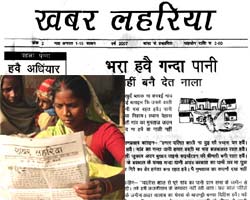
Nevertheless, in the age of the worldwide web, citizens’ journalism, bloggers, podcasters and community radio stations, there is at least one exceptional publication in India. Here are paraphrased excerpts from a website providing information about the unique weekly rural newspaper called, ‘Khabar Lahariya’, which in the Bundeli language stands for “news waves”. This publication is written, edited, illustrated, produced and marketed by a group of women, most of them from marginalised Dalit, Kol and Muslim communities, in Chitrakoot and Banda districts of Uttar Pradesh. The publication began in May 2002 in Chitrakoot and a second edition was launched in the adjoining Banda district in October 2006. Between both editions, ‘Khabar Lahariya’ currently has a print run of almost 5,000 copies, and a readership of over 25,000 in over 400 villages in both districts.
In 2008, the ‘Khabar Lahariya’ group registered itself as an independent organisation, ‘Pahal’, one of the only rural women’s media collectives in India. The eight-page newspaper provides a mix of news, information and entertainment specifically for its rural readers most of whom have low levels of literacy. The publication covers current political news, stories on the functioning of panchayats, the bureaucracy, schools and hospitals in the region. Its distinctive reportage of atrocities on women and marginalised sections of society critiques the tendency of contemporary media to sensationalise such incidents. Also distinctive is ‘Khabar Lahariya’s’ collective process of production which takes place over a two-day writing, editing and illustrating workshop.
‘Khabar Lahariya’s’ objective of reaching out to villages in which other forms of information and entertainment were limited has been enthusiastically worked at, and now the paper is something of a name in the area. ‘Khabar Lahariya’ is sold by the reporters and by other agents of the newspaper; copies are also available at small shops and tea stalls in the block headquarters and in remote villages and hamlets. ‘Khabar Lahariya’ is a unique example of “transformative education”. It has enabled rural, Dalit, newly-literate women to enter and transform the public arena of media and information creation, a space traditionally dominated by upper-caste men. In a crucial, innovative way, it strengthens grassroots democracy and challenges gender and caste relations. Its investigative style of reportage not only makes it popular with its readers but is also important in putting in place a culture of accountability and transparency. Several reports published in ‘Khabar Lahariya’ have enabled people to act and demand redress.
Considerable effort is made by the publication, not only to develop literacy skills of its readers but also to build other capacities, for instance, their abilities to move around and interact with various people in the public sphere, their levels of information and understanding on politics; inputs on writing and editing and so on.
Despite tremendous odds, the paper survives.


Mr. Bet Casino Bonus
In unserer Bestenliste könnt ihr einen der Anbieter auswählen und, wenn ihr wollt, direkt ohne Angabe
der Ausweisdaten loslegen. Bei diesen Casino Webseiten entfällt der KYC-Prozess,
ihr könnt direkt Echtgeld einzahlen und unmittelbar danach Casinospiele
zocken. Solange ein Online Casino eine gültige Glücksspiellizenz vorweisen kann, ist dieses absolut legal und seriös.
Finanziell werdet ihr nicht nur als Neukunde mit bis zu 200 Euro für eure Ersteinzahlung unterstützt, auch bietet das Ivibet Casino
dank seines VIP- und Treueprogramms weitere faire Bonusangebote an. Mit dieser Anzahl an Spielen im
Bereich der regulären Spielautomaten, Jackpots und
auch Tisch- und Brettspiele bewegt sich Powbet im oberen Segment der
Online Casinos ohne IDnow. Für eure ersten drei Einzahlungen sind insgesamt bis zu 1.000 Euro erhältlich, wobei im
weiteren Verlauf klassische Reloads und Freispiele erhältlich sind.
Hin und wieder zieht es auch uns zu einer nicht virtuellen Spielhalle, doch spielen wir in der Regel in online Casinos.
KryptoCasinos.com versteht sich als unabhängige Informationsquelle
zu Online-Casinos und -Casinospielen, die von keinem Glücksspielanbieter oder sonstigen Instanzen kontrolliert wird.
Seit dem Inkrafttreten des neuen Glücksspielstaatsvertrags 2021 dürfen lediglich Betreiber mit deutscher Lizenz legal
Glücksspiele online anbieten. Der Willkommensbonus bei Jackbit
besteht aus Freispielen und hat keine Umsatzbedingungen.
References:
https://online-spielhallen.de/stakes-casino-cashback-ihr-weg-zu-mehr-spielguthaben/
Australian VIP casino bonuses
This huge gaming and entertainment arena is Melbourne’s primary
gaming destination. All rooms and suites are non-smoking and offer
the latest touch screen technology, 24-hour guest service and
access to the resort pools and gymnasium. With everything you need for an unforgettable stay, from family-friendly entertainment at the Metropol Precinct to fine dining restaurants and bars at your doorstep,
Crown Metropol is designed so you’ll never want to leave.
Our in-house retailer offers a range of luxury Crown products available for purchase, including a
select range of Crown linen and At Home products.
Whether you’re here for a weekend getaway or an extended stay, The Sebel offers a refined,
comfortable experience. Discover boutique luxury at The Sebel Canberra, where contemporary
style meets exceptional service.
Crown works closely with the Victorian Responsible Gambling Foundation to ensure
a safe gaming environment. Play Rapid Roulette, eBlackjack, or eBaccarat with seamless interaction, no dealer required.
The casino boasts a wide range of traditional and electronic table
games. Crown Melbourne is home to thousands of electronic gaming machines,
catering to every taste and skill level. From live concerts to high-profile events,
Crown hosts entertainment that defines the Melbourne nightlife.
References:
https://blackcoin.co/imperial-poker/
premier casino Queensland
The Golf Australia handicap app must be presented to claim your Crown Gifts gift card.
Employees of the Crown Group of Companies,
Crown Melbourne, Crown Resorts, Crown Perth, Crown Sydney, Crown Aspinalls London and Betfair are not permitted
to collect Crown Gifts gift cards available for Golf Australia
members. Click here for the full Crown Gifts gift card terms and conditions.
If resort credits are not redeemed prior to check out, they will be deemed forfeited.
Crown Promenade is a modern hotel located within walking distance of Melbourne’s Central Business District offering city views
and friendly service. From birthdays and milestones to business meetings
and sundowners, indulge in a memorable experience at Crown’s array of
dining destinations today. With critically-acclaimed restaurants brought to you by the
world’s culinary elite, Crown offers dining
at its finest. Cancellations within 24-hours of check-in will result in forfeiture
of the full fee of one (1) night payable for the
stay.
References:
https://blackcoin.co/online-casino-welcome-bonuses-a-comprehensive-guide/
westorebd.com
paypal casinos online that accept
References:
westorebd.com
pizzaepp.co.kr
online poker real money paypal
References:
pizzaepp.co.kr