
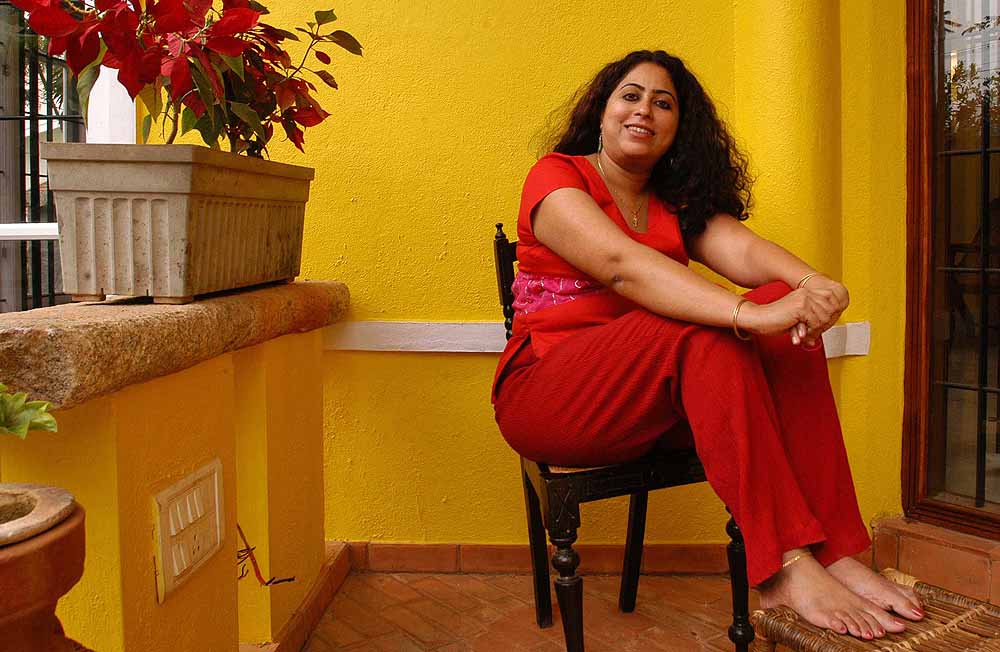
It’s probably easiest to introduce Anita Nair as a bestselling author, but one look at her vast repertoire of writing reveals that she is in fact, much more than that. Winner of multiple awards, she is one of the defining faces of Indian writing in English today and is also a poet, a screenplay writer, a blogger and an extremely witty columnist. While her much-translated and much-lauded Ladies Coupe is what she’s is best known for, Nair has continued to surprise and delight readers with her writing for over a decade now, all the while rendering restrictive labels like that of a feminist writer redundant. Indeed, what label would you put on a writer who has effortlessly charted her way through children’s writing, humour, travelogues and crime fiction? More recently with her new novel Idris: Keeper of the Light, Nair has made a promising new foray into a world of mythology that she’s planning to unveil in a trilogy. Riddhima Khanna and Saranya Mukherjee speak to her about her writing process, the making of Idris, and much more, in an exclusive interview to Kindle Magazine.
Your writings cover a wide range of genres and themes. How are you able to then distinguish between one character and the next?
See, it’s very simple for me. I don’t decide to write in a particular genre first. The organic process is that I think of a character and once I have this character in my mind the character then determines what sort of a novel it’s going to be, what genre it’s going to fall within. So when this happens I don’t really have a hassle or a problem distinguishing between one kind of character belonging to one particular genre and the other. This happens very naturally and organically for me.
Since you have experimented with a lot of different genres and forms, personally which genre do you like operating in most?
It’ll be hard answering that question because I realize that at the time when I am working on a particular novel that is the most important thing in my life at that point of time. So, then that is the particular genre that I want to work in. But when I am done with that novel and move on to another one then that becomes the most important thing for me. But what I would kind of pigeonhole it as is that it’s the novel. The novel is the form that I like the most.
When you’re writing the novel, what goes into the process of naming a novel?
Again, at the risk of sounding like somebody else is doing the whole thinking and writing process for me, these things just happen. They come to me from a strange sub-conscious part of my mind. Or probably there’s a greater unconscious being that tells me that this is what I should do and so very often when I start a book I have a working title. And then seldom have I actually gone on to use the same title because somewhere through the book, or at the end of the book, I get this feeling that this title is just a working title, it’s not working for me. Ultimately I want this book to be known as something else that is more enduring, more representative of what the book is all about. And so the titles emerge then. And when that happens it’s just kind of like a distillation of the entire process that has been going on in my mind right from the character to the plot to the narrative style to the landscape to the period the novel is set in, and so finally the title emerges.
Most of your novels are set in South India, and you yourself are from Chennai. Is there a certain autobiographical element in your work? Has there ever been a character that you have somehow managed to relate yourself to?
Well, you see, the protagonists of all my novels have had something of me in them. But it’s not like an exact replica, or it’s not made appearing in many disguises through various novels. There’s always some element of myself in it, which helps create that character. So when that character happens I would flesh it in a different way, the texture is very different. Because its very layered and it’s a very complex process. But that is just the foundation. There after what I build up- the character- is an amalgamation of a part of me and mostly imagination.
Of late there has been a sort of a literary trend where authors prefer to break up their narratives into several parts- for example a trilogy. There are people like Amish, Amruta Patil and even in the West there are some like Samantha Shannon doing it. So do you think there’s some sort of an advantage in telling your story in different parts?
Well, see the newest novel that’s just come out, Idris, is part of a trilogy. Now the original plan for me was to do a single novel and not a trilogy. When I started researching the period, I had intended Idris to be a character that was supposed to be really minor, a really insignificant person who breezes in and breezes out. But somewhere this character became so dominant in my mind that I had to rethink the story entirely because that is going to fashion the mindscape of the hero- who the father is. And so the trilogy just happened because of the compulsion to tell a story to a greater depth and dimension. Also since I was doing a historical novel there were so many facts I found which I thought were so beautiful and interesting that I wanted to share it with the rest of the world mainly because nobody knows about that period of Southern Indian history, there’s nothing to fall back on. It’s not like reading about the Mughals or reading about colonial history. So I thought that since I have anyway gone into this so deeply I might as well make a proper job of it and I had a chat with my publishers and said that I didn’t think I could contain this within one single novel. I would be burdening my reader with too much information, so I would rather break it up into three parts and do it as a trilogy. Also a trilogy allows me to dwell on the characters growth at greater length rather than just whizzing through it.
When you are writing a trilogy, do you think there’s some sort of challenge you face in terms of continuity, in terms of connecting with the reader through three consecutive books?
I’ll only know when I start on the next book. I’ve just completed this novel, which took my five years to write. I know at the back of my mind that writing it will not be as difficult because I’ve pretty much done all of my reading. So now it’s a question of siphoning and taking out what I need rather than putting in everything I’ve collected these first five years.
Speaking about Idris, most of your books have been very socially relevant. They are like a mirror to the reader. Since this time you are actually going back in time is there anything that is relevant in terms of our current society when you are reading it?
Absolutely! Idris is the story of a journey. The story itself is about this young boy who believes that it is his destiny to be a suicide warrior. And when the time comes, that he is going to try and assassinate the king of that region because he thinks that it is his destiny. Now the question is how different is it from the way we have jihadis. What makes a jihadi a jihadi? Apart from just the monetary aspect alone, there are a lot of jihadis who go into it because of all the silly propaganda that is stuffed into their head. So that is a question that this book asks, which I think is very relevant in this time and age. Then in the course of the journey various incidents take place, which are very similar to the problems faced by people today like underemployment where labourers are underpaid. For instance, the book ends in the diamond mines of Golconda where the mineworkers know what a diamond is and what is the value. But ultimately what they get paid is pittance, which is again the same thing that is happening in industries like farming and mining. Times have changed but if you look at the mindset of the exploiters manipulating the exploited you would see nothing really has changed. And finally there is something that I thought was relevant was this incident when Idris meets a few baniyas from Surat. They talk about how, then, it was considered a sin to kill any animals in that region. To kill an animal was a criminal offence. So a baniya talks about how a merchant comes there and he shoots a peacock and they catch hold of the merchant and they beat him to death. Idris asks that aren’t you committing violence too? He questions that the same people who preach non-violence, go ahead and think nothing of actually violently killing a man. These are the kind of questions, which if you look at it, is what is actually happening today. If you looked at the pogrom which happened in Gujarat and so on, it’s pretty much the same kind of a story. The setting might be different, the time frame might be different but the questions that I have asked in the book are very relevant in this time and age well.
At a recently concluded literary festival in Kolkata you spoke on a discourse on feminism and forbidden pleasures. However, you’ve never wanted to be termed a feminist writer. In one of your most famous works Ladies Coupe you tell the story of a group of women, each of who was bearing the brunt of patriarchy in their own different way. Why is there a reluctance to be termed a feminist writer?
As a writer, I think my first dharma is towards writing and not to be identified with any particular ideology or thought process. The only thing I want to do is a write good honest book. Books that are not just relevant to this time and age but will also endure to a greater period of time. To be cast into a particular kind of writing is not what I set out to do because if I had a particular ideology that I wanted to belong to, then I would work towards it. I would stay away from the world of literature. As a result of labeling myself as a writer synonymous with a particular genre, there are going to be curbs put on me- which means that tomorrow I cant write a novel where I have an anti-hero as a hero. Because that would immediately raise a question that why is she going away from what she always been writing. Even in a book like Idris there are three very different kinds of women I talk about and each one of them, to some extent, voice what I spoke about at the meet, which is the need to articulate the ‘I want’. And I’d like to do it in my own time and in my own style and not be forced into writing only women centric novels. It’s almost a defense mechanism when I say please don’t refer to me as a feminist writer. I am a writer who may write female centric stories but I also will write male centric books.
You have been translated into 30 languages and you’ve been writing books for quite a while now. It’s very fascinating because your stories have a very commonplace Indian setting with very Indian characters. So how do you think globally the readership has changed in its attitude towards Indian writing in English and women writing in English, from India?
I really can’t comment about how they actually perceive it, because it’s hard to say what they perceive. But what I do know from my interactions with reader groups across the world is that for them it doesn’t matter whether they are sitting in Latvia or the US, or UK, or Spain, or Italy, or any other part of the world. The fundamental issues that strike people whether they live in India or elsewhere- are the same, nothing changes. It’s just the settings that are different. It’s not going to be exactly a replica of the lives that they lead but if they see that there is something in the story that they can relate to then that book automatically gets elevated into a book that speaks about the human condition rather than just speaking about particular situations. So I think it’s because readers everywhere are able to understand or are able to sense the questions that I am asking through my writing. Because that is what I do through my writings- I ask questions that are not really questions at the face of it. And that makes them think and maybe look at their own lives and the decisions they have made thus far. That is why I think it doesn’t matter that I write about very regular Indian lives and Indian stories, but within the writing the readers should be able to connect and it strikes a chord somewhere in them, so it becomes that much more acceptable for them.
On a light note, what are some of the funny or strange questions that you have been asked with regards to your work?
I write a lot about sex. So one of the strangest questions I have been asked, and this by a very senior journalist, was “What does your mother think about you writing about sex?” I actually laughed and I said that to my mother that is the least of her worries. Her greater worry is the fact that coming from a family where everyone has jet-black hair even when they are in their 70s and 80s, I am greying. So that to her is unnatural. She’s not worried about me writing about sex because it is a natural thing. And then of course which I have been asked like “have you experienced everything that you have written about?” And I tell them that if I were to have had experienced everything that I have written about then I would be a basket case. I wouldn’t be writing. So allow me some imagination!!

kings casino aktionscode
Casinoonline.de ist Teil der #1 Online Casino Authority®, dem weltweit größten Casino-Affiliate-Netzwerk.
Im Chat bekamen wir die Auskunft, dass die meisten und die wichtigsten Spiele auch online vorhanden sind, jedoch
gibt es keine Angaben darüber, welche Spiele nach Download zur Verfügung stehen. Das Casino kann entweder online direkt im Browser
benutzt werden oder auch per Download, allerdings nur für Windows, nicht für iOS.
Das Live Casino ist zwar vorhanden und wird von Evolution Gaming betrieben,
bietet jedoch weniger als 10 Live Tische an. Die nur 200+ Casino Spiele
werden alle vom Software-Hersteller Microgaming zur Verfügung
gestellt und somit finden Sie keine große Auswahl.
/ We’re delighted to hear that you’re satisfied with our casino.
Wir freuen uns, dass Sie unseren Service schnell, effektiv und
freundlich finden! / We’re pleased to hear you’re happy with our vouchers!
Von gewaltigen progressiven Jackpots über populäre Tischspiele bis hin zu innovativen Real Dealer-Games haben wir alles, wonach das Herz begehrt.
Die mobile App bietet Android-Nutzern die Möglichkeit, ein hochwertiges Spielerlebnis direkt auf ihren Geräten zu
genießen. Die Captain Cooks App wurde speziell entwickelt, um Spielern ein erstklassiges Casino-Erlebnis direkt auf
ihren Mobilgeräten zu bieten. Egal, ob Sie Spielautomaten, Tischspiele oder andere Casino-Klassiker bevorzugen – mit der mobilen Version des Captain Cook Casinos müssen Sie auf nichts verzichten.
References:
https://online-spielhallen.de/umfassende-pistolo-casino-bewertung-meine-10-jahrige-erfahrung/
Australia premier casino
This is a casino that doesn’t just host Aussies; it walks beside them.
Whether you’re camped under the stars or weaving through the city, the
full Casino Mate experience flows in your hands, raw
and ready. Its mobile outback is a fluid expanse,
stretching across phones and tablets with no app to weigh
you down. For Aussies via Casino Mate Australia login, it’s a boundless trek through gaming’s untamed
heart. Crafted by a band of inventive trailblazers—think Microgaming, Play’n GO, and Quickspin—this
isn’t a stale collection; it’s a thriving ecosystem. The mobile version is adapted for this type of phone extremely
well.
The mobile version of Casino Mate Australia is optimized for iOS and Android devices.
On signing up, you can secure up to $1,400 and 80 free spins, divided across your first four deposits.
Before contacting support, consider checking the FAQ section, as your query may already be addressed
there. The level of quality of the services
provided can be described as good, so the casino receives a rating
of 8.04 out of 10. Considering all the pros and cons (6 vs 1), we are ready to recommend this casino.
Regional support paths and AUD-first cashier views reduce friction when you’re setting
limits, verifying documents, or planning a
withdrawal window that fits your schedule. The gambling site has a good reputation among gamblers.
There is also a very interesting hidden bonus on Sundays.
References:
https://blackcoin.co/top-online-casino-bonus-offers-2025-claim-your-free-bonuses/
VIP casino rewards UK
All three 2025 Christmas games reheat longstanding division rivalries.
“I think we all need to take a nice, good, long look in the mirror after this,” Dan Skipper said after the Lions’ loss to the Vikings.
But a loss would serve to make for a bitter Christmas
Day. The Lions won’t have Avonte Maddox in the
secondary — who was already stepping up
in a depleted unit — and currently have 11 questionable for the game.
McCarthy and Brett Rypien (Emergency 3rd QB), running back Jordan Mason,
linebacker Austin Key, tackle Brian O’Neill and tight end T.J.
Expect Dan Skipper to get more run at left tackle.
Thursday’s game was merely an encore, the cherry on top of
a season in which the Lions simply never solved their offensive line’s inconsistencies.
Highlights and game-by-game analysis from the Detroit Lions’ thrilling overtime win over
the New York Giants. The Vikings would add a field goal to make the final score Vikings.
On the first play of the quarter, the Lions committed their fifth
turnover of the season—Goff got strip-sacked,
and it was recovered by the Vikings.
References:
https://blackcoin.co/treasure-island-ti-las-vegas-hotel-casino/