
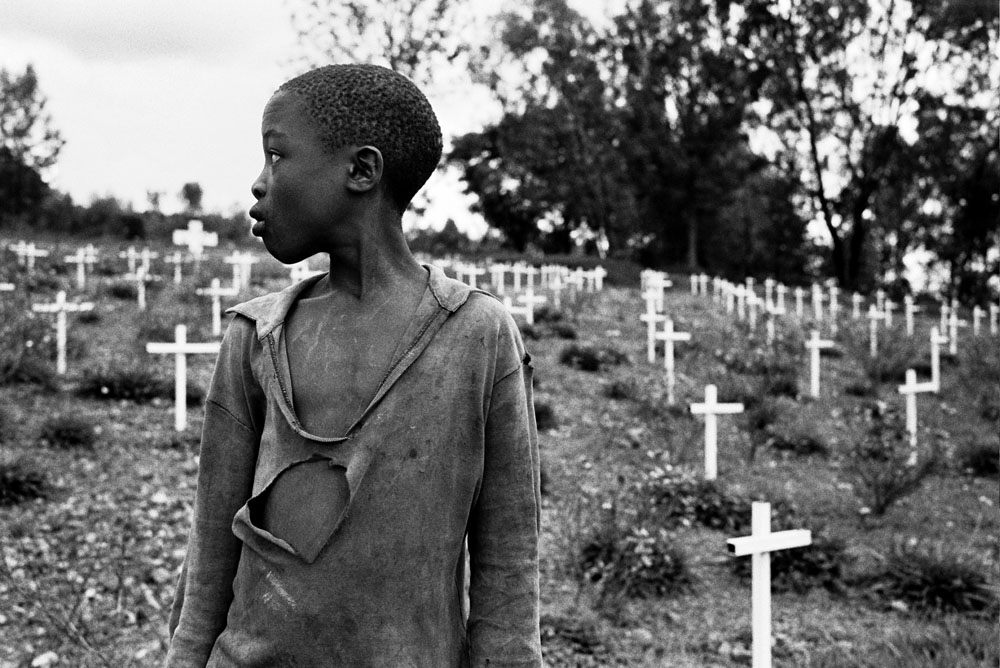
Twenty years after the Rwandan genocide, the world – which largely ignored the carnage at the time – is gearing up to ‘commemorate’ it. But have we really learned anything or has this become yet another historical atrocity that we ritually mourn and fetishize, while we continue to repeat it in slightly altered ways in hauntingly similar contexts? Azad Essa explores.
The blood spilt across the thousand hills of Rwanda cast a dark blot on our collective humanity. Around 800,000 people had been killed. That was July 1994. The murderous rampage that became known as the Rwandan genocide began 100 days earlier.
I
In 2013, CNN listed Rwanda as one of the top ten places to open a business. The World Bank, for its part, said that after Mauritius, Rwanda was the second friendliest place to conduct business in Africa. Corruption today is also low in this countryside of rolling hills and plush fertile land, teeming with bananas and maize and dotted with tea plantations. Kigali is a bustling city. It is also unusually clean. President Paul Kagame, the former general of the Rwandan Patriotic Front (RPF), which took Kigali in July 1994 and ended the genocide, has driven entrepreneurship and technology, in a bid to rid this nation’s association with murder.
For a country that suffered such a dramatic break down in social order, the turnaround is almost a miracle. The new government focused on economic recovery as the driving force towards reconciliation. To deal with perpetrators of the genocide, the Kagame administration used the gacaca courts, hundreds of thousands of community-based tribunals that were used to deliver justice. To deal with corruption, the government created a harsh system of accountability for those in public office. Rwanda is one of the fastest growing economies and is considered the most improved nation in sub-Saharan Africa since 2005; one million people were raised out of poverty between 2006 and 2011. But the country is still almost entirely dependent on foreign aid.
Twenty years have passed since the genocide paralysed this nation. And the country is certainly vastly different from the Rwanda that hosted the 1994 genocide.
But the memory of Hutu extremists who sought to annihilate the Tutsi community is just an anecdote away. And yet it’s difficult to distinguish between the two communities. Inter-marriage and generations of cohabitation has made the difference between the two communities shallow. The ethnic cleansing that took place in 1994 needed verification via an ID card. While animosity between the communities was not altogether new, the scale and pace of brutality demonstrated during those three months in mid 1994 was something no one could ever have imagined.
Backed by a manic state apparatus, the ordinary were pushed to join an efficient, well-oiled killing machine that worked meticulously to hunt down Tutsis, and other dissidents. Mutilated bodies were flung into the streams and rivers; their bloated body parts surfacing some time later.
Civilians were instructed to kill their neighbours, priests became collaborators and allowed massacres in places of worship. To refuse cooperation was suicide. For 100 days, the extermination of the Tutsi became a vocation; militia woke up each day, with a plan, an itinerary detailing a village or a district to strike, a new killing field to blood.
But the memory of Hutu extremists who sought to annihilate the Tutsi community is just an anecdote away. And yet it’s difficult to distinguish between the two communities. Inter-marriage and generations of cohabitation has made the difference between the two communities shallow. The ethnic cleansing that took place in 1994 needed verification via an ID card.
The impact of those nightmarish days on this society is evident. Hundreds of thousands of children have since grown up without parents or an extended family. An entire generation has been scarred by the blades of machetes wielded by the Interahamwe (Hutu para-military brigade). It is said that half a million machetes were imported to carry out the massacre.
II
The devastation that wrecked the people of Rwanda remains one of the greatest failings of the UN and the leaders of the world’s most influential countries. When the violence started, the world packed up and left. The Hutu militia are said to have targeted the Belgian troops already in the country as UN peacekeepers. It was a ploy to push them out. Three months earlier, the US and the UN had suffered a tremendous embarrassment in Somalia and the Clinton administration did not want any further loss of American lives in Africa. As the violence spread across the country, Bill Clinton said that the US would only act in cases where the conflict affected its own national interest. Four years later, in 1998, when Clinton visited Kigali, in what was dubbed the ‘apology tour’, he attributed his failures to intervene when Rwanda was burning to a lack of intelligence. “There were people like me sitting in offices, day after day after day, who did not fully appreciate the depth and the speed with which you were being engulfed by this unimaginable terror”.
But even while Europe and the US refused to act and the UN top brass fumbled to find an adequate response and the blood flowed down the Kigara river and the bodies filled mass graves in Kibuye, there were some who felt compelled to act.
Despite its collective failure, not everyone from the UN left Rwanda. Lieutenant General Romeo Dallaire, force commander of the UN mission in Rwanda, who was originally in the country to mediate a peace agreement between the Tutsi rebels and the Rwandan government, refused to leave Kigali when the blood bath ensued, effectively disobeying his instructions. His troops, consisting of no more than 450 poorly equipped soldiers, had no authorised mandate but they valiantly focused on creating safe houses for Tutsi civilians, guarding them with their lives.
The tragedy of course, was that Dallaire received very little support from his superiors at the UN. Other heroes, included members of the Red Cross, who remained, negotiated with drunken killers, and even spoke out against the atrocity – a departure for an organisation that prides itself on ‘impartiality’. But the killings were so brutal that the organisation had to change its own rules in Rwanda. Up to 70,000 people were saved because of the efforts of the Red Cross.
III
Twenty years have passed and the commemorations are likely to flow, to mark the occasion. The tragedy will be remembered.
But like the ‘never again’ promises that followed the Holocaust all those years ago, there is little evidence that there are enough mechanisms to halt the murder of thousands of people today. It is not only that political leaders are reluctant to act. Often, it is the mainstream media who are ill-equipped to tell the story. For instance, as the genocide moved into its fifth week in 1994, with the human cost reaching 400,000 victims, the global media – along with heads of states from across the globe – took the time to fly to Pretoria to witness Nelson Mandela’s inauguration as the new president of the Republic of South Africa. Five days later, the French foreign minister used ‘genocide’ to describe the killings in Rwanda.
Likewise (as if in a duplicative tryst with destiny), when South Africa was preparing to bury Mandela in December 2013, half the world’s media, myself included, along with fifty heads of state, again descended on that country, ignoring, to a great extent, the chaos in the Central African Republic. Incidentally, December 5, the day Mandela died, is said to have been one of the most catastrophic in the conflict in the CAR.
Covering the reaction to Mandela’s death, despite its importance, left me perturbed. The structural bias of power in global leadership and in the media towards stories that are deemed unfamiliar, or out of reach, has not shifted. Two decades later, and even in an age of social media and the Internet, it’s still the same, old story, of deference.
When the Europeans spoke of ‘genocide’ in 1994, they referred to legal ramifications as a way to get accountability following the conclusion of the conflict and not as a way to stop the carnage in the first place. Avoidance seems to be at the heart of international diplomacy when the national interests of the powerful nations are not directly at stake.
But inaction often allows guilt to become a commodity. Commemorations are usually hollow, stilted ceremonies that fetishist loss and victimhood. It allows an industry to take form; it creates patterns and institutionalises delayed action. That there is a holocaust industry today, which does little but exploit the memory of the holocaust, so much so that it gives Israel significant immunity from its crimes against the Palestinians, is fast finding mainstream acceptance. The Nazis also cleaned out gays, gypsies and the physically challenged, but these became footnotes in the larger story. The Israeli, Zionist identity was sold, as it is still sold today, as a Biblical odyssey. It is not debatable that it has been built primarily on the backs of those who perished in concentration camps.
By and large, Rwanda has turned into a state that finds vindication for its actions through the failure of the international community to act when it counted most.
This is why little has been done to address Rwanda’s crimes against the Hutu refugees in 1996-’97 during one of the earliest phases of the Congo Wars. Even less is said of the country’s cross-border transgressions, such as its interference with – and alleged siphoning of resources from – its neighbour, the Democratic Republic of the Congo. Kagame’s authoritarian style, his intolerance of dissent and the shrinking space in Rwanda for political diversity or media freedoms are well documented. Kagame is also seen as perpetuating the ethnic divide by alienating Hutus from his government.
In this way, it is possible to conclude that shame alone will never prompt action towards the saving the lives of ordinary people, especially if they are of a certain nationality or a certain colour. General Dallaire, in an interview with PBS in 2004, suggested that authorities still seemed to believe that some lives were simply more important than others. He had received orders to rescue foreigners, while given orders not to intervene for the local population.
Inaction often allows guilt to become a commodity. Commemorations are usually hollow, stilted ceremonies that fetishist loss and victimhood. It allows an industry to take form; it creates patterns and institutionalises delayed action.
This is partly why there has been no action in Syria – the biggest tragedy of the 21st Century– even as the death toll limps towards 150,000 people. According to UNICEF, more than 1.2 million children are now refugees and another 5.5 million inside Syria are desperate for humanitarian assistance. It’s partly the reason the CAR remains in the periphery of the world’s attention as the carnage, albeit of a smaller scale than Rwanda, occurs daily. Likewise, in the bid to champion a western styled democracy in Myanmar, the state-driven cleansing of Rohingya Muslims has merely become collateral damage in a struggle for business access and competition over resources.
In this way, Rwanda is fast becoming a state to watch, and fear. Author René Lemarchand describes the genocide in Rwanda as the “tropical version of the holocaust”. It is difficult to say that any lessons were learnt since the Holocaust. Certainly Rwanda tells us we haven’t learnt anything at all.

888 casino aktionscode einlösen
Deshalb ist es unserer Meinung nach ratsam, nach einem besseren Online Casino zu suchen, in dem
Sie beruhigt spielen können. Um den jeweiligen Simsino Bonus freizuspielen, müssen Bonus- und Einzahlungsbetrag innerhalb eines Monats jeweils 40-fach im Casino umgesetzt werden. Zusätzlich gibt es nach der Ersteinzahlung noch 50 Freispiele für den Book
of Dead Spielautomaten. 25 Stufen verhelfen dir zu einem bis zu 25%
Cashback sowie Freispielen und Bonusgeld. Die Option eine Frage per E-Mail ()
einzureichen, steht wiederum rund um die Uhr zur
Verfügung.
Darüber hinaus bietet das Casino einige konkrete Möglichkeiten, das eigene Spielverhalten einzuschränken. Da Simsinos Casino eine Online-Casino-Website ist, gelten unabhängig davon, wo
Sie spielen, dieselben Sicherheitsstandards. Öffnen Sie einfach
Ihren Browser und spielen Sie überall und jederzeit.
Die Plattform bietet außerdem Live-Streaming und eine reaktionsschnelle mobile Zugänglichkeit, sodass auch unterwegs gewettet werden kann.
Spieler können in HD-Streams aus echten Casinostudios interagieren, chatten und spielen.
References:
https://online-spielhallen.de/wunderino-casino-login-ihr-tor-zu-spannenden-spielen/
Cobra Casino Freispiele ohne Einzahlung
Rant Casino App herunterladen
References:
https://online-spielhallen.de/smokace-casino-cashback-ihr-weg-zu-mehr-spielguthaben/
Online gambling sites
The best casino bonuses come with low wagering requirements and work across a wide range of games.
Most online gambling sites support a wide
range of payment options, including bank transfers, crypto, card,
and e-wallets — all of which offer fast turnaround times.
For anyone who wants the closest thing to a land-based casino from home,
Evolution is the gold standard at any live online casino Australia.
There’s a lot to take in when playing at an online casino in Australia for real money.
You’ll also want to double-check the bonus terms as many AU
online casinos won’t apply promos if you
deposit this way. If you’re playing at
an online casino in Australia for real money, a reload can give your balance a bit of extra kick.
See our list below to find the best Australian online casino real money
sites. Yes, online casinos are legal for players within Australia.
Some AU casinos excel at one thing, and others excel at
another. We will tell you all that you need to know
about top pokies, their RTPs (return to player), volatility, and features.
However, taking full advantage of the best casino sites in the market can be a tough task.
bank craps rules
Let’s face it—people download Tubi because it
just works. Some people might not be willing to pay ten dollars every month for one
thing they’ve seen before. When the app is installed, you look at the content,
hit play, and you’re done. With so many services charged by subscriptions
and secret costs, it’s hard to believe it, but this one doesn’t do that.
Parents can restrict access to certain shows or
movies to ensure a safe viewing experience for children.
“If the company goes into administration, [workers] want the support of their government to ensure the doors stay open.” “They’re not highly paid people — they’re struggling with the cost of living as everyone else is and they can’t afford to take a pay cut.”
Shares in Star Entertainment have been suspended from trading on the stock exchange after it failed to lodge its financial results.
Personalise the news and Eligible shareholders who wished
to retain their Unmarketable Parcel were required to return a Share Retention Form
to the share registry by the Closing Date. The Small Holding Sale Facility was conducted in accordance with The Star Entertainment Group’s Constitution and the Australian Securities Exchange Listing Rules that enables all listed companies to sell shareholdings
valued at less than $500 (Unmarketable Parcel).
References:
https://blackcoin.co/best-uk-high-roller-online-casinos/
gjejstaf.al
online casino real money paypal
References:
gjejstaf.al
Whitney Ingrahm
Exactly what I was searching for, regards for posting.
www.adpost4u.com
anabolic steroid tablet
References:
http://www.adpost4u.com
australian internet casinos
References:
Gambling for beginners
References:
https://graph.org/10-Best-Online-Casinos-for-Real-Money-Play-in-2026-04-20