
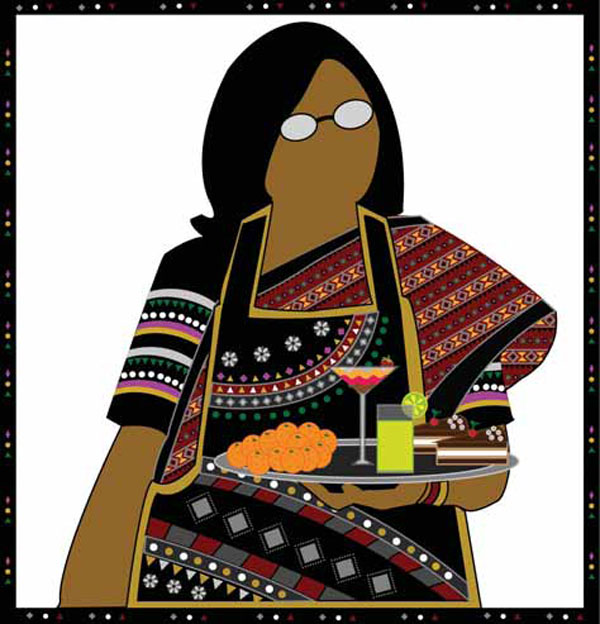
The late Tarla Dalal’s cookbooks have been an essential ingredient of our national culinary memory and a rite of passage for the pre-internet generation. In this tribute, Nidhi Dugar Kundalia reminisces about gravitating to, and retreating from the influence of the iconic chef.
On those dull summer afternoons of my adolescence, when I was being trained to turn from a girl into a woman, I was handed a few sepia coloured Tarla Dalal cookbooks: The Joys of Vegetarian Cooking; Curries and Kadhis;and Italian Food. The well-thumbed, splotchy pages spoke of my mother’s early cooking days. The chocolate soufflé page had brown splatter on it. Her own notes were scribbled throughout the book- rasam powder, homemade biscuits, gundappam, rava dosa…. She did complicated calculations taking help from her conversion table in the chapter “Weights, Measures, Temperatures and Times”, converting decimals into fractions. For my mum, and many others of her generation, Tarla Dalal was a mother in absentia. She had answers to all their basic questions. How do you know when a thing “just begins to boil”? How do you define “chopped”? How can you be sure that the milk has scorched but not burned? How hot is too hot to touch? How do you tell firm peaks from stiff peaks? Through her cooking books, Tarla reassured, offered options, suggested alternative ingredients and explained complicated cooking terms.
“I was engaged to a man in the US. He used to write to me saying he wanted to eat this and that; all complicated things I had never heard of ”, Tarla had said in an interview once. “I was 20 years old and could cook only DBRS-Dal Bhat Roti Sabzi. To please her husband, a young woman will learn to cook the food he wants”. That’s how she started and became a part of a nation’s subconscious. She approached her domestic being on a dopamine overdose of enthusiasm and determination. For many other women cooking then, cooking was like running a race, which involved multiple tasks: prepare meals on time, plan menus with variety, serve dishes in style, keep the kitchen clean, don’t complain about the effort it took, and importantly, don’t appear too eager for praise. For Tarla, her husband’s praise was the prize. Perhaps it was in patriarchy’s best interest to get onto the pedal of tradition, veil it as love, and drive women into a guilt trip. Up until I turned 16, I was not compelled to learn cooking. Mum understood that academics and extracurricular activities were more relevant to my life in school, and she let me be. But the fact that I would have to, in due course, learn how to wield the iron skillet and joust with the spatula, was not far away from my thoughts. I learnt this through a cycle of my mum’s life in the kitchen.
The years of reading English novels and being fed on a diet of cookery shows on television and Hindi movies had filled her with the romantic notion of cooking for her family, captured in fuzzy, warm tones of enchantment. This soap opera ideal of cooking kept her satisfied for some time…. It wasn’t until the women’s movement blossomed in our families about a generation ago – with women taking up jobs or joining their husbands’ businesses’ – that she realised this kitchen of hers was a trap. She vanquished the spirit of domesticity the way Virginia Woolf had killed her Angel in the House. Cooking, then, became a bone of contention: is it alright to hire a cook or do we change our eating habits and order out? Neither option seemed right. She loved the taste of her own concoctions too much to cede control to another person, and she couldn’t find a good person in any case. She could either spread herself too thin, in an attempt to prove that she could ‘have it all,’ or be honest with herself and accept that the system is rigged against women and Tarla Dalal is her deliverance from it all.
Born in a time when television was available only in a few homes and Doordarshan displayed that slow-moving gyre accompanied by that equally dismal music for several minutes before the broadcast began, women’s groups would get together to write simple compilations of domestic recipes, like Rasachandrika, the classic Saraswat Brahmin Cookbook produced (and still in print) by the Saraswat Mahila Samaj in Mumbai. Occasionally, author S. Meenakshmi Ammal would come out with a book like Samaithu Paar in Tamil, meant to be a guide to young brides. Food channels were decades away and men were not supposed to discuss their culinary skills in public. That’s when the original creator of the Indian cookbook industry, Tarla Dalal came along. 100 Calorie Snacks; Acidity Cook Book Popular Restaurant Gravies and other cooking books, covering almost any niche subject area you can possibly think of, were sold in bookstores, toy shops, video libraries, boutiques and supermarkets, changing the Indian kitchen staples forever.
So, while my mum cooked ‘fancier’ dinners, I – for the sick yearning for food that adolescents suffer – took evenings off from school work and followed Tarla’s books to the letter, hoping to get what they promised to yield. ‘Serves 4’, Tarla’s book said… and it bang on did. Her footnotes at the bottom were essential. Yet, if the first thing a cadet cook learns is that words can become tastes, the second is that a space exists between what the rules promise and what the cook gets. It was partly those steps in between—the melted Dairy Milk’s gleam or the chastened and improved look of the eggs mixed with fine sugar—that were often more satisfying than the completed cake. But the trouble also lay in the same good words that got you going.
Tarla’s writing was predominantly one of gamely volubility, as she sought to entertain along with pictures of jujubes houses and ice-cream jokers. The dal makhani came with a swirl of fresh cream on the top and rice was baked in tomatoes a là Spanish style. Her discourse, though, came with that overarching framework of spice and exoticism. But navigating the twee-ness of it all was the primary enticement of food writing, of course – the promise of voyeurism and its illicit delights.
The prospective miracle of her cookbook was immediately apparent: you start with a feeling of greed, find a list of rules, assemble a bunch of ingredients, and then you have something to be greedy for. You fire up with an ache and close each stage of the cooking with an object, whereas in most of the life of appetites— marriage, courtship —you begin with the object and finish with the ache.
Cookbooks, in India, were necessitated by the rapid progress of the urban middle class in an economy riding high on the victory of public sector enterprises. As mommies started crossing the Great Indian Divide, cross-cultural, inter-state marriages became a natural corollary. Tamil women married Sikh men and Gujarati women walked into Bengali households, beaming with confidence and armed with Dalal’s cook books, most prominently her maiden one -The Pleasures of Vegetarian Cooking, which was published in 1974.
This food nation also started getting constructed by Indian immigrants abroad: from langars, Diwali parties, wedding feasts, curry houses and Indian diners in western nations to diasporic writing—Gandhi to Naipaul, Ismail Merchant to Madhur Jaffrey—there came a great deal of food-centric writing experience catering to all palates. So, while Thangam Philips started setting standards in culinary education, Jiggs Kalra raised the profile of Indian restaurant chefs and Camellia Panjabi was promoting Indian regional food, Tarla Dalal became to food documentation in India what Jesus Christ is to the Gregorian Calender. Dalal’s honour was deserved, for the many cookbooks she’s sold or the dramatic difference she’s made to broccoli and babycorn sales, but the culmination of Dalal’s philosophy that can be seen in today’s generation, which doesn’t realise that idli is a South Indian recipe while kachori is a typical North Indian one. This mixing of Persian, Mexican, Mughal, Italian with Parsi, Kayasth, Marwari, Anglo-Indian and of course, Telangana and Karnataka influences, might point to our syncretic reality, tellingly absent from our politics or cricket. But at the same time, it also led to not just Pan- Indianising the regional foods of India (which is really a reference to Delhi restaurant owners North-Indianising the rest of India’s food) but also “Indianising” (i.e., North- Indianising) food from other lands.
This espousal, alteration, import substitution – call it what you will –sometimes took almost vile forms, and this too, was popularised by Tarla, whose influence is now the cordon bleu of chutney cooking. Her food essentially became foreign food made easy and palatable for Indians who want to eat Indian food but pretend it’s something else. Just as soap operas on TV give their viewers a somewhat faux ‘modernity’ and ‘cosmopolitanism’.
So when Donna Hay blogged about that extra dollop of butter in mushroom risotto and Joy The Baker posted her Pear Crumble Coffee Cake, and while my friends at school made the authentic Bolognese pasta from Jamie Oliver’s website, I clandestinely pushed my Tarla books further behind in my larder, where they belonged. Tarla, like all good things, had to go.
Other good things go too. The cult of the cooking vessels— the tandoor, the thermocol boxes for keeping the food cool, the smoker, the stone grinder for batters, the marble mortar and pestle—all seem to be over. Paula Wolfert has a new book devoted to clay-pot cooking, but it feels too ambitious; we have tried too many other modish pots, and learned that after their hour is done they will live out their years forgotten and alone, on the floor of the closet, alongside the fondue forks, sizzler trays and indoor barbeque grills. Even the imagery of cooking has changed. Sometime in the past decade or so, the actual eating line was breached.
Now the cooking magazines and the cookbooks are filled with half-devoured dishes and cut-open vegetables. Ritu Dalmia’s new cookbook devotes an entire page to a stilllife of an empty glass, streaked with remnants of a greenish soup, already consumed, as an accompaniment to its recipe. The point, you see, is not to entice the eater but to ennoble the effort.


Royal Casino aktueller Bonus
Konkret bedeutet dies, dass die Gewinne sofort als Echtgeld
gutgeschrieben werden, ohne Wenn und Aber. Gespielt
wird grundsätzlich auf dem niedrigsten Level, meist
mit einem Einsatz von 10 oder 20 Cent. Das Angebot ist einmalig und mit das beste Angebot, das Spieler
ohne Einzahlung erhalten können. Dann ist es egal, ob ein Spieler mit diesen Free Spins 100 Euro
oder nur 20 Euro gewinnt, da er nur 20 Euro auszahlen darf und das restliche Geld dem Casino erhalten bleibt.
Free Spins ohne Bonusbedingungen werden seltener von Casinos vergeben, zum größten Teil nur in besonderen Aktionen wie zum Beispiel an VIP
Spieler, etc… Je nach Status können Free Spins in Höhe von 1 Euro und mehr pro Spin erhalten werden.
Ein Jackpot, der mit zunehmender Anzahl von Spielern, die ein bestimmtes Slotspiel spielen, wächst.
Ein Mini-Spiel, das innerhalb des Basisspiels des kostenlosen Spielautomaten erscheint.
Oft müssen Sie den maximalen Einsatz spielen, um Bonus-Spiele und Jackpot-Preise freizuschalten.
References:
https://online-spielhallen.de/netbet-casino-mobile-app-ihr-spielerlebnis-fur-unterwegs/
online pokies australia
No — the browser-based app offers full functionality and bonuses instantly.
The dashboard offers real-time balance tracking, bonus
status, and payment history all in one place. Returning players can sign in instantly,
while new members register and verify in minutes.
No fees are charged for any of these choices, and the processing time as well as the deposit/withdrawal limits vary based on the chosen banking
method. When it comes to banking, A Big Candy Casino provides a satisfactory range of secure and swift deposit and
withdrawal methods. There are six levels in A Big Candy Casino’s loyalty program,
each represented by a sweet treat.
This A Big Candy casino delivers non-stop thrills
with over 2,000 online pokies australia titles, lightning-fast PayID payments, and
generous bonuses up to AU$1,000 plus 100 free spins.
To cash out, players need to ensure their account is verified, which may include providing identity documents.
Such games make BigCandy casino stand out by offering refreshing alternatives to standard play.
While these drawbacks exist, most players agree they are manageable and do not
overshadow the overall value of the Big Candy casino.
Its navigation is clean, which makes game discovery intuitive, even for new
players.
top online casino PH
You won, mission accomplished, now it’s time to withdraw.
Whether you’re playing a positive progression (the Paroli
System) or a negative progression strategy (Martingale), you should always proceed with the utmost caution. Remember
when I said I would give you my own gambling tips that my friends never
want to hear about? Their common point is that their game sessions per
bet are instant – you either win or lose.
Still, there are a few things to keep in mind when playing at online casinos.
To determine whether an online casino offers bonuses and
promotions worth your while, we look at the terms and conditions.
Hence, we appreciate it when online casinos accept methods that
are convenient for online gambling, such as PayID or Neosurf.
Speaking of apps, few Australian online casinos offer them for Android or iOS smartphones or tablets.
Besides playing at online casinos, Australians also
frequent their land-based counterparts to enjoy their favourite form of entertainment.
You shouldn’t settle for Australian online casino sites that need 3 days to approve a
payout request. Wagering requirements must be within industry limits, the
bonuses should be accessible to all players, and the
expiry dates should be reasonable. The three things these games have in common are that their RTP is
very high (usually 98%+), the gameplay is quick, and
they all offer a different type of gameplay.
This adds yet another element to playing casino games, and I’m all in for this one.
References:
https://blackcoin.co/betmgm-your-ultimate-online-casino-experience/
renbrook.co.uk
paypal casinos online that accept
References:
renbrook.co.uk