
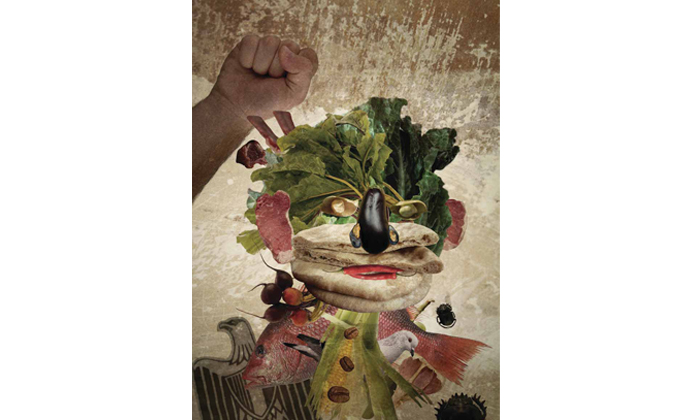
In an iconic modernist novel by a Nobel Prize winning writer (Hunger, Knut Hamsun), an unnamed young man wanders daily through the city streets, frantic and crazed, with a starving belly and a head full of words. He wants to eat, he needs to eat, but he can’t (and sometimes he won’t), he has no money and no food. Deprived of the most basic human need, his mind freewheels, and this sets the stage for both creative introspection and a strange meditation about the world.
While literature might have derived nourishment from thinking individuals who are lacking something as fundamental as food – by a psychological exploration of their subjective consciousness, or a social analysis of their being knowingly prevailed upon to commit crimes while hungry (think of Jean Valjean in Victor Hugo’s Les Misérables who is convicted for stealing bread for the starving) – a hungry person is also an angry person.
And when a collective mass of people are hungry, so hungry that they are perpetually malnourished, starving and yearning for food which is beyond their reach because of a famine, or more often, because of food price inflation, they will eat bullets but still raise their voices against the injustice they face.
Riots over food are not new to humankind. Some of the greatest upsets in political order have happened because the people had starved for too long and simply could not take it anymore. Everyone has heard the remark (inconclusively attributed to Empress Marie Antoinette), “If they don’t have bread, let them eat cake!” before the 1789 French Revolution where the rising price of bread was an important factor in crystallising people’s discontent against the Ancien Régime. The American Civil War had its Southern Bread Riots in 1863 and the Russian Revolution in 1917 was preceded by the St. Petersburg Bread Riots. Hunger creates a mass of people who have nothing to lose by rebelling in extremis.
The problem of hunger in our times seems to be accelerating despite growing global prosperity. In the last years, there have been food riots in several countries. People have been fired upon and killed as they demand food and jobs, to the point where Mohamed Bouaziz immolating himself sparked revolutions (complete or incomplete) in Tunisia, Egypt, Yemen, Libya, Morocco, Gabon, Ivory Coast, Bahrain, Algeria, Mauritania, and more to come.
The ultimate causes of the 2007-2008 interlinked global food, fuel, finance crises are not fully transparent, but the link to speculation in the commodities and foodgrains markets is undeniable. While the financial institutions and banks were bailed out with taxpayers’ money, the national governments are left saddled with massive debts (which, in the West, were presented as deficits requiring drastic cuts to essential social services and public goods like education), and a worldwide downward spiral has been created whereby there is more unemployment, less food, more inequality, rising inflation, and greater violence. In February 2011, the World Bank announced that since last June alone, an additional 44 million people have been pushed into poverty worldwide.
If imperial-colonial administrations had their inflection points in the famines (think of the repercussions of the Irish Famine or the Bengal Famine) – where it became obvious that the authorities would let millions die simply because they did not value the life of their subjects – modern day rulers don’t fare much better with (what I call) “ecopolitical crises”. What is happening in Asia, Africa, Latin America are a series of ecopolitical crises that have their roots in bad policies – ill-managed debts, skewed taxes, lack of concern about food price inflation, agricultural diversion towards commercial biofuel production, subsidy cuts for the essentials. A bad harvest, an IMF prescription, a clampdown on freedom of expression, and so on, adds to the explosive mix. If the end of the 20th century was defined by the 9/11 events, then the 21st century has been inaugurated by the global anger of millions upon millions saying “Enough” in the face of starvation. How can an individual be expected to value herself and those around her or defer to insitutions when she is hungry and on the verge of joblessness and homelessness.
The contours of this ‘lessness’ faced by the masses are various – they are fenced out from emigration to affluent countries even as their own corrupt and unrepresentative governments are propped up by Western countries, their recourse to judicial remedy is nonexistent in the face of blatant violations of human rights, and while their misery is splashed across the global print and televisual media 24/7, their lives remain unameliorated.
Meanwhile, in the Euro-American ‘first-world’ countries, food is aplenty, albeit generally imported. As the average Westerner opens his fridge and decides what to eat, he might pick up a microwaved ready-meal with one hand, and flip the TV on with the remote in the other, where news pictures of starving, rioting, faraway strangers are interspersed with commercials about weight-loss clinics or previews of celebrity cookery programmes. What kind of imaginative distance and schismatic memory is involved in being able to live in such a world? Equally, in the ‘rising powers’ of Asia (India, China), the well-to-do will bemoan, patronise or ignore the protests as they gather at lavish banquets that might put transnational gastrodiplomats to shame.
Mahatma Gandhi used fasts as a political weapon, workers and activists often go on hunger strikes. Food is basic but also sacred. It becomes a part of one’s being, and all the knowledge in the world will not bring a morsel to a person’s lips unless she lifts it up. The brute materiality of hunger has both a physical and a spiritual dimension. This is why religions have often prescribed and proscribed the sharing of food as a defining aspect of belonging, and required prolonged periods of semi-starvation (such as the Christian Lent or the Muslim Roza). Politically, at a macro level, hunger leads to resistance, and equally, at a micro level, a conscientous refusal of excessive indulgence, might lead to an understanding of the lessons of eating.
There is something that the creative endeavours of literature, poetry and drama do tell us about hunger, which is that plenty makes us sated, craven, and thoughtless. An excess of food is no exception. The starving poet in the garret and the struggling writer leading a hand-to-mouth existence may often be stereotypes in today’s world of literary celebrations, but the fact remains that we are what we eat.
In Maxwell Anderson’s 1937 play The Feast of Ortolans, set on the eve of the French Revolution, the aristocrats sit at a meal of ortolans (the ortolan is a songbird that was famed as a delicacy to the extent of being eaten with head covered to savour the full sensation; it is now forbidden) oblivious to the revolution until the host is murdered and the Bastille prison is stormed. The question now is whether we have people in power who, like the privileged ortolan-diners, are unable to appreciate the significance of their satedness and the hunger of others?


500 euro casino deutschland
Ob ein Casino sicher genug ist, solltest Du auf der Grundlage von Lizenzen, Zertifikaten und anderen Genehmigungen entscheiden,
die von externen Agenturen ausgestellt werden.
Aber vergiss nicht, dass neue Casinos in Bezug auf Kundenservice und Auszahlungsprozesse ungetestet sind; es wird kein Kundenfeedback zur Überprüfung der online Casino Spiele geben. Die beliebtesten Kontaktmöglichkeiten sind E-Mail,
Telefon und Live Chat, und die besten Casinos bieten einen 24/7-Kundendienst.
Halte Ausschau nach mobilen Apps wie MuchBetter, die ihren Kunden wesentlich bessere Bearbeitungszeiten und niedrigere Gebühren (wenn überhaupt) bieten. Die besten Casinos bieten häufig Echtzeit-Zahlungsmöglichkeiten gegen eine geringe Gebühr an. Die meisten Casinos bieten eine breite Palette an Zahlungsmöglichkeiten an – von traditionellen Banküberweisungen, elektronischen Geldbörsen wie Skrill,
PayPal oder NETELLER bis hin zu Kartenzahlungen.
Im Gegensatz zu traditionellen Casinos ermöglichen Online-Plattformen den Spielern,
mit virtueller Währung zu spielen. Wenn Du
um die Chance auf den Jackpot spielen willst und das Beste des Jackpot-Spiels erleben möchtest, solltest Du
nur die beliebtesten Casinos wählen, die das Vertrauen einer bedeutenden Anzahl von Spielern genießen. Eine Einsatzbedingung bestimmt, wie
oft man den Bonusbetrag durchspielen (Umsatz) muss. Hunderte
von Freispiele bei Mega Moolah, ohne dass eine Einzahlung
erforderlich ist, kann dies ein Versuch sein, das Glücksspielen bei einem unregulierten Anbieter zu locken. Wenn Du
jedoch anfangen möchtest, um echtes Geld zu spielen, musst
Du Dich registrieren, Dein Konto verifizieren und eine Einzahlung tätigen. In Online Casinos
ist es jedoch möglich, kostenlose DEMO Online Slots auf dem
Computer oder Smartphone zu spielen.
References:
https://online-spielhallen.de/rocketplay-casino-login-ihr-tor-zur-gaming-welt/
Real money casino games Australia
We provide a diverse selection of 350+ games across all major categories.
PlayCroco keeps its game library fresh by frequently
adding new slots. Sometimes, bonus codes for free spins might pop up out
of the blue!
Cash rewards exceeding $20,000 have been won on Bubble Bubble slots
and $24,000 on Asgard. Punters can contact support
via email or live chat or find information in the FAQ section. PlayCroco’s support service is
ready 24/7 to answer questions and solve problems. The minimum deposit amount depends on the method and is $10
or $20. To deposit funds, use the methods commonly used
in Australia-based establishments. The app is always available regardless of browser functionality – all games and options
are now accessible from the desktop.
Claiming the welcome bonus at PlayCroco is easy. It’s quick, responsive, and lets you enjoy
all the casino action wherever you are. You don’t need to download an app—just
open the PlayCroco site through your mobile browser on any Android or iOS device.
References:
https://blackcoin.co/casino-forecast-beta/
quick withdrawal gambling
Minnesota responded with a strong offensive drive.
It’s an appropriate way for the Lions’ postseason run to
end, as Detroit hasn’t looked anything
like their former selves in a long time. They finished with 231 yards, marking their third-worst effort under Campbell.
The Lions finally found a little life on offense
with a 12-yard screen to Montgomery and two more touches for the Lions’ power
back for another 11 yards. The Vikings couldn’t do anything with the
good field position, settling for a 56-yard field goal attempt, which was
good. Still, the Vikings kicked a 52-yard field goal to
make it 10-7 Vikings. Tyson Chandler ran the ball four times for 15 yards, and Brosmer added five rushing yards of his own. The Lions moved to midfield at the end of the first half thanks to an impressive on-the-run throw
from Goff to Jameson Williams for 15 yards.
References:
https://blackcoin.co/casino-gambling-the-kinds-of-casino-bonuses/
jobsercher.com
gamble online with paypal
References:
jobsercher.com
Maryanna Gal
I love your blog.. very nice colors & theme. Did you create this website yourself? Plz reply back as I’m looking to create my own blog and would like to know wheere u got this from. thanks