
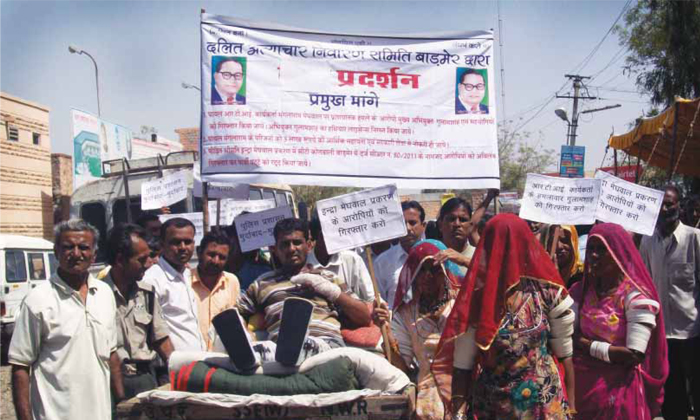
Gordhan Balai is a dalit from Rajsamand district of Rajasthan. In a state, where pagdi (turban) is identified with pride, dignity and tradition, Gordhan’s pagdi was snatched by some goons from the Gurjar community and thrown into a flaming tandoor. He was warned that if he was ever found wearing the colourful turban (a self-proclaimed Gurjar style) again, he would be thrown into the fire. At the time of my writing this article, Gordhan is wondering whether all are equal in this country. He is one among thousands who have suffered attacks by non dalits in recent years. Take the case of the atrocity in Paali district of Rajasthan, where a dalit father was killed in Bollywood Jamindaar style revenge, in broad daylight in a crowded market, for naming his daughter Baisa (Baisa is the popular name for girls in upper castes, mostly Rajputs).
“The number of dalit atrocity cases has also increased because of the use of the SC/ST Atrocity Prevention Act, 1989, which is one of the finest acts only on paper.”
In a feudal and caste-driven society, it’s only a book called the Constitution of India that gives hope and strength to the most tolerant section of our society. Beyond that, there is a complete vacuum; no political and social institutions are bothered about the pain and sufferings of dalits in the state. Studies reveal that the number of dalit atrocities has increased in the last 10 years. There are many reasons for this. Firstly, awareness and education among dalits have given them the courage to register cases against their harassment. Secondly, the claims for their rights have provoked the non-dalits. Thirdly, the upper castes have shifted their focus and presence to the urban and suburban settlements. They are focussing on education, jobs and trade instead of fighting for small pieces of land and resources, which are no longer the major means of growth for them. Look at the villages of Rajasthan- there is less scope for OBCs to fight and snatch power and resources from the upper castes. In most cases, the clashes are between Dalits and OBCs, who have obtained socio-political power in recent years. They are in businesses and controlling resources. To gain more power and wealth, they eye dalits as easy targets. In 80% cases of dalit atrocities, culprits are OBCs. The worst affected areas are the southern and the western parts of Rajasthan. OBCs react more brutally when they find dalits raising their voices and demanding their rights.
The number of dalit atrocity cases has also increased because of the use of the SC/ST Atrocity Prevention Act, 1989, which is one of the finest acts only on paper. In the last 10 years, the rate of punishments has been almost negligible. Almost 30 % of the cases have been registered through the courts, which shows that the system is still not good enough to help dalits register their cases and get the culprits punished. The state level monitoring vigilance committee has been constituted only twice in the last 20 years. According to its rules, Chief Minister is the head of this body but they hardly have any time to attend the meetings and take this job seriously.The biggest tragedy is that there is still no strong dalit movement in the state. The existing efforts are small and ineffective.
In the 90s, the Kumer dalit atrocity case in the district of Bharatpur, Rajasthan became a turning point for the present-day dalit movement in the state. In Kumer, 19 dalits were burnt alive. This made dalits of the state rethink and group against attacks and harassment by non-dalits. But it was left to evolve and grow in small patches through the state and without the support of the political class; it didn’t take over and emerge as a powerful and effective dalit rights struggle. Efforts made by political representatives have done nothing for the social justice and welfare of dalits in the state. The reason is very clear. Today, there are 56 MLAs from dalit and tribal communities in the state assembly but most of them are puppets in the hands of mainstream political parties. They are not the real leaders of their communities; moreover, they are the dummies and robots controlled by the state and national level leadership (who are mostly non dalits) of the political parties. The case of Manglaram is one of the best and most recent examples for it. Manglaram is a dalit who comes from Bamnor village in Barmer district of Rajasthan. He applied for information regarding developmental works in his panchayat under the RTI act. His efforts to make the system accountable made the local body representative angry. Manglaram was beaten up publicly by goons hired by the sarpanch during the panchayat’s social audit. Today, he is unable to walk, having suffered multiple fractures in both legs. He sat on strike for 65 days in front of the local administration; he wrote to and met the Chief Minister of the state but nothing worked. No FIR has been registered against the sarpanch so far. In this whole clash, the local MLA, who is also a dalit, helped the other section instead of standing with Manglaram in his fight for justice. Manglaram says, if he would have been a real dalit leader, who came to power through a struggle for the dalit community, he might have not done this to him. One more case is from the Paali district where a young dalit, Mohan Meghwal tried to contest village body elections against the will of influential non dalits. He was brutally murdered. They first cut his body with swords and knives and then drove four-wheelers on his dead body.
Some well funded NGOs have mushroomed over the years, but they see the whole issue as projects drawing funds. Now, how can we think about a big social movement and action for change through these parasitic efforts? The leadership that emerged in some areas is growing old and there are few fresh faces to take over. However, some dalit activists indicate that dalits have started sensing the need to get organised and stand up together. They give examples of the recent panchayat elections in the state where dalit candidates won 35 general seats. Among them, 17 were dalit women candidates.
The future of dalit struggle in Rajasthan looks critical. The stranglehold of OBCs is increasing day by day. The caste-based divide and hatred between the backwards and dalits are widening. Even tribals and minorities are not spared by OBCs. OBCs are more confident and power-blind because of their control over state politics. The whole drama, protests and uproar by them in the recent Bhanwari Devi case is a fresh example. They are loaded with money, muscle power and control over resources; their hunger for social status and respect is increasing. The dalit thinkers and activists believe that if dalits, upper caste and minorities stand up together, it would be an equalised fight, but then this might take some time; maybe a couple of years more. Even upper castes need to keep a check on the uncontrollable OBCs.
Whether this works or not, the days are not easy for dalits in the state. After all who listens to the scream of the ants?


Izzi Casino Freispiele Bonus
Das Blackjack in Dragon Money hat die besten Auszahlungsquoten, die ich je in casinos gesehen habe.
Die Plattform ist benutzerfreundlich, mobil optimiert und bietet innovative Spiele.
Von klassischen Slots über Tischspiele bis hin zu eigenen „Fast Games“ –
Dragon Money bietet eine gute Mischung bekannter und eigenentwickelter Spiele.
Das Support-Team ist rund um die Uhr verfügbar und bietet schnelle sowie professionelle Unterstützung.
Das Sportwetten-Angebot bietet wettbewerbsfähige Quoten, verschiedene Wettmärkte und Live-Optionen. Evolution Gaming liefert den Großteil der Live-Tische und sorgt
für flüssiges Gameplay und professionelles Dealer-Verhalten. Der Live-Casino-Bereich bei Dragon Money
bietet eine authentische Casino-Atmosphäre, in der Spieler per HD-Videoübertragung mit echten Dealern interagieren können. Die intuitive Benutzeroberfläche ermöglicht es Spielern, einfach zwischen den Spielkategorien zu navigieren und neue Titel zu entdecken. Tischspiele umfassen beliebte
Varianten von Blackjack, Roulette, Baccarat und Poker.
Die Plattform umfasst Hunderte von Spielautomaten, klassische Tischspiele, Live-Dealer-Tische und eine umfassende Sportwetten-Sektion.
References:
https://online-spielhallen.de/24-casino-freispiele-dein-komplett-guide/
Casino Club Bewertung
To begin playing at Zoome Casino, the minimum deposit is just
AU$20. Everything is transparent and regulated — from how games work to how your money is handled.
At Zoome Casino, we believe online gaming should always be about
fun and excitement — not stress or financial pressure.
I treat it like entertainment and set a budget every time I play.
I’ve been playing at Zoome Casino for a few months now and
honestly, it’s one of the smoothest platforms I’ve used.
The games load fast, payouts are quicker than I expected,
and the support team actually responds — which is rare these
days. The world of online casinos is growing fast in Australia — but not every site is worth your
time (or money). It offers a wide range of payment methods that are tailored to Australian players.
Zoome Casino has lots of promotions for new and returning
players.
Australian players seeking a reliable, entertaining, and rewarding gaming destination should definitely
give it a try. Mobile optimisation ensures seamless gaming across all devices,
while the comprehensive live casino creates authentic gambling experiences that rival physical venues.
Fast withdrawal processing demonstrates respect for players’ time and
financial needs, with e-wallet transactions completing within hours rather
than days. Popular FAQ categories include account
management, bonus conditions, deposit procedures, withdrawal processes, and technical troubleshooting for mobile users.
References:
https://blackcoin.co/59_online-casino-vip-programs_rewrite_1/
casino winning strategies
There is no monthly subscription fee and you can begin to watch TV shows
and movies for free right now by downloading the Tubi app.
Tubi is always adding great new content, so stay tuned to find
out what you can watch completely for free right now on Tubi.
Follow the topics, people and companies that matter to
you.
“If they can’t arrive at a deal on a funding facility, they will likely go into voluntary administration in an effort to restructure their capital structure. Experts say the distressed company is likely to enter voluntary administration as its attempts to secure a financial lifeline go down to the wire. Last month, the operator secured a deal with Hong Kong investors to sell its stake in its Brisbane casino at Queen’s Wharf, while taking full ownership of a Gold Coast casino precinct. It’s another significant setback for the casino giant, which has faced financial distress and regulatory scrutiny during the past two years. Star Entertainment has failed to secure a crucial financial lifeline, as a refinancing deal with Salter Brothers Capital is withdrawn.
References:
https://blackcoin.co/top-10-popular-casino-games-trends-innovations-in-igaming/