
The month of January owes its name to Janus, a two-faced Roman God who is connected to doors and transitions; the faces of Janus look simultaneously behind and ahead, just as the beginning of the year is a time to reflect on the past and the present.
2012 is a rather special year, some prophecies herald an apocalypse. The catastrophic end of the world in 2012 has been projected onto the film screens and ingrained in our collective imagination as being marked by a drama involving earth, water, fire, fury, or some combination thereof. This, rather cinematic, eschatological vision is both appealing and beguiling for the way in which it promises an end to our worries as individuals and as humankind.
I suppose the end of the world could be construed as worrisome. It might certainly give children bad dreams. But, on the whole, I’m rather inclined to say: So what? What if the world ends in 2012? How does it matter? And more importantly, to whom does it matter?
Does the end of the world worry those who are starving, suffering, and dispossessed? Does it worry anyone who understands that we are all mortal beings with death being the one inescapable fate we all share? Does it worry those who have inwardly reflected enough to understand that all worldly attachments are transitory?
In any case, I have little faith in the power of an absolute apocalypse or dramatic planetary chaos. And even so, were 2012 prophecies to be true, at a stroke, the ‘grand’ end of the world might cut short all our pleasures, but it would also vanquish all our pains. Actually, there is nothing to fear about an preordained and unalterable total annihilation of humankind; if no one survives, so won’t you, and in that case how does it matter what comes after the end of possible memory?
On the other hand, if it is a matter of probability that some might survive, then the end of the world becomes a game of roulette and so the number your ball is on assumes a salience. Only if there is a chance of outliving the end of the world, can the apocalypse have any teeth. For in that case, the hope that one might last beyond the end, is the genesis of the despair that one might not. (Or, if you happen to be a pessimist, exchange the placing of the words ‘hope’ and ‘despair’ in the sentence above). Anyway, hope and despair often form a mobius strip; it is not always clear where and how one blurs into the other.
Imagine a dialogue:
‘What lies at the end?’.
‘The end of what?’.
‘The end of everything…anything. The end of an endeavour, the end of the world, us, the universe’.
‘Nothing. If it is the end, then things end’.
‘But something must last, isn’t it? that which makes things last, that which lasts…’
‘Perhaps…but what lasts?’.
‘Hope’.
Forget about Apocalypse 2012. Think about Hope.
Hope is a word we use everyday in numerous contexts. In our interactions with others, and our communication with ourselves, in the most profound myths, in the smartest political slogans, in the most ordinary emails, we encounter the word ‘Hope’ so often that we have come to take its meaning for granted (my own name ‘Nitasha’ means ‘ever-renewing hope’!).
Yet what is hope? What is hopefulness made of? What exact thought patterns make it possible for us to hold on to hope?
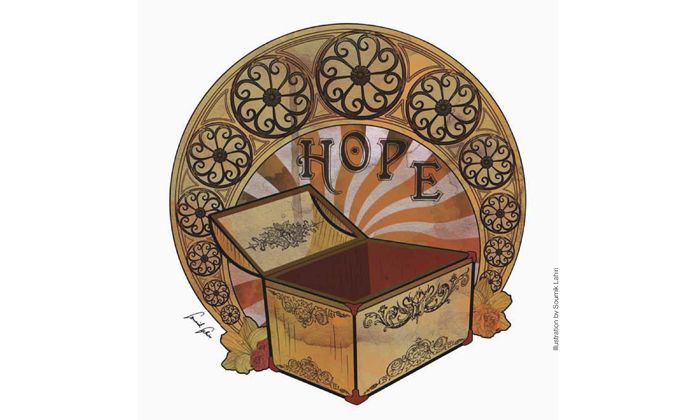
In the ancient myth, when Pandora (the supremely gifted first woman of Greek mythology) opened her box, out came the evils, curses, disease, pestilence – though there are different interpretations of what she carried, what she did, and how – but the last thing in that box was ‘Hope’. After all the troubles and pain had been loosed upon humankind, the last compensation was hope (in most versions, it stayed in the box).
Likewise, Sisyphus being condemned to roll a boulder up the hill everyday and watch it fall back down again through all eternity is another mythic tale that places ‘hope’ squarely in the middle of what seems to be a pointless labour. Those who are sacrificed to the altar of hope are paradoxically often perceived to be ‘hopeless’. Camus imagines Sisyphus happy as an absurd hero because he realises his hopeless condition and acts in spite (literally, in spite) of it.
Hope is a strange word. It is often associated with good things, even though it need not be. The distinction between ‘hope’ and ‘good hope’ is made clear when we look at the geographical tip of South Africa. The sailor Bartholomew Diaz originally named it ‘Cape of Storms’, but the King John II of Portugal had it renamed as the ‘Cape of Good Hope’. The addition of ‘good’ before ‘hope’ makes it clear that not all hope is good, as Aristotle recognised when he distinguished between ‘Elpis’ (hope) and ‘Euelpis’ (good hope).
As I read the scholarly literature on the philosophy of hope, I realised that while a theological conception of hope is automatically about good hope, it is the philosophers’ notion of hope that orients us better. For instance, Aristotle saw hope as underlying and creating not just confidence (which then leads to courage), but also fear. When we do not have hope, we are resigned to circumstances, and we do not have the anxiety of fear; ‘fear about an uncertain future remains only so long as hope concerning that future remains’. Similarly, it is hope that makes deliberation possible, we do not deliberate over wishes: ‘While we can wish for the impossible, we can hope only for the possible’.
Hope has a complex relation with futurity. Reflections on more recent philosophers suggest that hope is actually not always about dreaming a tomorrow but may equally be about avoiding the today. Hopefulness, therefore, might best be thought of as a transitory fleeting feeling. We tend to feel hopeful at certain moments before the burden of things as they are strikes us again. But, this is not to be rued, because ‘Hope does not need to last in order to be; what lasts is what is taken from hope, which is nothing more than what we had before, namely ourselves’.
I remember when the year 2000 happened. On a fairly deserted campus, I watched the fireworks on the telly in a provincial English city by the sea, there was fog when the millennium dawned, but the Y2K (the ‘millennium bug’) scenario failed to live up to its hype. When 21.12.2012 (the widely predicted date for the end of the world) comes to pass, the world will still be turning, no apocalypse will come and deliver. We will have to continue with our lives, and hold on the hope that things will get better.
Hopes may be mistaken, but hope never is. The ironies of hope are poignant in the Robert Browning love poem ‘Last Ride Together’ where the line occurs: “Who knows but the world may end to-night?” We are the repositories of hopes latent in us. For everything would grind to a halt without the strange bird of hope. Hope is that bridge which connects every present we face to any future that might come to pass. It is the seed of human survival, the mother of dreams, the soil upon which all virtues thrive. Without some sort of hope, one cannot face another day.
We’ll never know if the last dinosaur on the planet sighed or smiled at the finality of an end. So, I’ll say again: Forget about Apocalypse 2012. Think about Hope. There’s plenty of chaos around anyway…There is a super-massive black hole (named Sagittarius A*) at the centre of our galaxy, the Milky Way. We cannot satisfactorily account for either the presence of dark matter in the universe or the changing tides of the human heart. Much of our inner and outer world remains a mystery to us during the course of our lifetime. In a complicated world, we yearn for enlightenment but often overlook the simplest ways to make things better.
Hope, I’d say, is a movement in time that we make within our thoughts. And in this sense, it is eternal.

Princess Casino Echtgeld
Martin Campbell wurde nach Pierce Brosnans erfolgreichem GoldenEye zum zweiten Mal mit der
Einführung eines neuen Bonds betraut, wie im Februar 2005 zusammen mit
dem Filmtitel bekanntgegeben wurde. In Zusammenarbeit mit der Fleming-Familie
wollte er die Geschichte in den 1960er Jahren ansiedeln mit dem noch aktuellen Bond Pierce Brosnan und seiner Lieblingsdarstellerin Uma Thurman als Gespielin.
Erstmals Interesse an einer Neuverfilmung zeigte 2004 Kultregisseur Quentin Tarantino.
Die erste DVD-Version erschien 2007 in einer Standard-Ausführung sowie mit einer Bonus-DVD und fünf Postkarten. US-Dollar, womit der Film 2025 auf Platz 8 der umsatzstärksten Bond-Filme stand.
November 2006 – wurden mit dem Film 82,2 Millionen US-Dollar eingenommen.
Bereits eine Woche später – noch vor dem deutschen Kinostart am 23.
Die deutschsprachigen Darsteller synchronisierten ihre
Rollen durchgängig selbst.
Die deutsche Synchronbearbeitung entstand bei Interopa Film in Berlin. Die
Videoaufzeichnungen im Club sind auf Blu-ray Discs, die Bond mit einem Sony-Blu-ray-Player abspielt, und
die Monitore des Bankiers sind vom Typ „Sony SDM-HS95PRS“.
Auch Mathis (Sony Ericsson K700i) und Dimitrios (Sony Ericsson K750i)
nutzen Sony-Ericsson-Handys genauso wie der „falsche Polizist“ am Flughafen mit einem Walkman-Modell.
References:
https://online-spielhallen.de/beep-beep-casino-aktionscode-ihre-vorteile-erklart/
stake casino app
As stated in the separate section of the website, Stake Casino
supports provably fair gaming. As expected,
the casino applies the latest SSL encryption for data safety.
As I was told by the customer support agent, the casino reserves the right to
randomly request KYC documents. It loads fast, so it’s easy to jump into gaming wherever I am.
Even though there’s no dedicated Stake casino app yet, the mobile version holds up
well.
Betkin Casino is a Curaçao-licensed platform established in 2023.
Up to 5,500 USDT across first three deposits Players will also benefit from a very large sign-up bonus an…
Seven Casino is a secure, trusted site that provides reliable crypto payouts.
Up to 7500 USDT in any supported cryptocurrency Optimized for desktop and mobile, the platform ensure…
However, it’s crucial to check the specific casino’s policies,
as some may have minimum withdrawal limits or processing
times for verification purposes. They hold licenses from reputable
gambling regulatory authorities. This simple yet engaging game involves betting on the outcome
of a dice roll.
Luck Nation Casino Australia
With an open terrace and unimpeded views of the city skyline, allow yourself to be whisked away to a
world of sparkling champagne, concierge services, complimentary breakfast and evening canapes
at Crystal Club. Riverside Café serves up the tastiest meals
every day. Step inside this stylish room, complete with over 460
Gaming Machines, a dedicated bar, delicious café and room
only promotions. We have made some important updates to the Crown Rewards Rules effective Wednesday 1 October 2025.
You can check your Crown Rewards balance online (once you
have registered) or at any Voucher Issuance Kiosk
(VIK) located on the Casino floor.
From world-class Japanese cuisine to relaxed al fresco dining, there’s something
for every taste and budget. Crown Perth is renowned for its vibrant gaming floor, competitive jackpots,
and secure environment. Crown Perth reserves the right to
refuse entry to any persons considered unsuitably dressed.The dress standard for the Casino
is smart casual. The dress standard for the Casino is smart casual; customers must be clean, neat and tidy at all
times.
References:
https://blackcoin.co/candy96-casino-in-australia-real-money-play-for-cash/
etalent.zezobusiness.com
paypal online casinos
References:
etalent.zezobusiness.com
dfc1318.kr
online casino real money paypal
References:
dfc1318.kr