
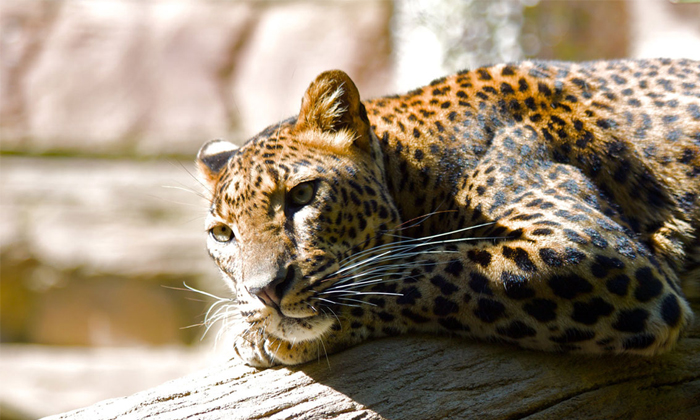
While every tiger killed in the wild generates massive furore, no one sheds a tear for the hundreds of leopards that are brutally being eliminated from their habitat. Wildlife activist and big cat lover, Belinda Wright once told me that while tigers may see the light of the day, leopards could soon be staring at complete annihilation of their species. She revealed that more than 4,000 leopards have been killed in less than a decade and hardly anyone ever took notice of it.
These figures are official and do not reveal the gory side of the story. It is widely believed that the number could be much higher considering the increasing man-animal conflict and great demand for leopard skin. Even in the well protected tiger reserves across the country, where each and every tiger is monitored by the hour, survival and protection of leopards isn’t part of the mandate.
A forest official once told me, “Tourists want tigers. Tigers get revenues. No one comes to see a leopard.” Also, leopards concentrate more on human habitats for an easy kill and this has brought them in direct conflict with the locals. For them, leopard is a nuisance that feeds off them and needs to be eliminated. This bloody vendetta has put the animals’ survival at stake.
As a child, I was witness to this conflict in my village where people and the beast shared the same space. Surrounded by patches of dense forests, the village was right in the heart of the leopard territory. With no tigers around, the spotted cat ruled these forests with great ferocity and terror. Stories of the beast feasting on humans and cattle are part of the common folk lore.
Immensely superstitious, people of Garhwal in Uttarakhand have often confused man-eating leopards to evil spirits that devour human blood and flesh. Back in time, the fear of the beast compelled locals to build temples to please the gods. My village has two such temples: the Narsingh temple is dedicated to a half man, half leopard god; the Mata ka Mandir has a Durga riding a tiger. Every year, goats are sacrificed to appease the gods.
On several occasions, I have been at the heart of these man-eating sprees and sensed the uneasy calm that would descend on the village and its adjoining areas. A voluntary curfew would be in place as sun touched the western horizon. Doors and windows are firmly shut and no one would dare to step out. The ones who dared often ended on the leopards’ dinner table.
The nerve-wrecking story of a nine-year-old girl still gives me cold creeps. On one such man-eating leopard days, this girl continued to play in the open despite her mother’s warning. After several attempts, her mother cursed, “If you don’t come inside, leopard would eat you.” Halfway through the sentence, she saw the child being dragged away by a leopard. Before she could even react, the big cat disappeared into the dark of the night. No one dared to follow the blood trail and next day a search party could find pieces of her blood soaked clothes that were also used for performing her last rites.
The famous Jim Corbett book on the man-eating leopard of Rudraprayag; who killed more than 150 people over 8 years is a legend. “That leopard killed at will,” a local told me at the very spot where the predator was shot dead by Corbett himself. The master hunter too was moved by the beauty of the animal and even rated him above the tiger in his memoirs.
But, these stories have become part of the legend and instances of man-eating leopards have gone down drastically in the past few years. Stray incidents of leopard killing cattle do happen, but the trends have witnessed a sharp drop. For every cattle killed, leopards sometimes do have to pay for their lives. Revenge killing by poisoning has long been adopted to silence the big cat.
These trends are not confined to my village and stories of leopards being exterminated relentlessly throughout the country is a cause of great concern. Seizures and intelligence inputs suggest a large nexus of poachers slaughtering these beautiful animals for their body parts in collusion with the locals.
At present, the situation is alarming and dwindling forests, extinct prey base have added to the animals’ misery. An ugly confrontation between the man and the animal threatens the very survival of the species. Poisoned, trapped and chased by the poachers, the leopards seek refuge in the forests that aren’t there. Blinded by tiger conservation, the government’s policy also has no place for the leopard.
The hunter has become the hunted. And if this hunting goes unabated, the leopard may go the cheetah way amidst rising tiger numbers.

Pistolo Casino Auszahlungsprozess
Insgesamt hat Scorsese mehr als 60 Filme gedreht und seine Arbeit wird auch in Zukunft
die Filmindustrie beeinflussen. Nach seinem Studium an der New York University begann er
seine Karriere als Regieassistent und drehte seinen ersten Spielfilm „Who’s That Knocking at My Door“ im Jahr 1967.
Der Film zeigt auch die dunklen Seiten des Glücksspiels,
wie Korruption, Geldwäsche und Betrug. Der Film zeigt seinen Aufstieg
und Fall, seine Beziehungen und seine Konflikte mit der Mafia
und dem Gesetz. Der Film zeigt das Leben von Sam „Ace“
Rothstein, einem jüdisch-amerikanischen Glücksspiel-Experten,
der das Tangiers Casino in Las Vegas für die Chicago Outfit betreibt.
Für regelmäßige Besucher von Las Vegas gibt es im gesamten Film eine Reihe weiterer erkennbarer Orte.
Scorcese und De Niro hatten vor Casino bereits sieben Mal zusammengearbeitet,
so dass dies ein Kinderspiel war. Trotz des Mangels an Auszeichnungen war die Leistung der
gesamten Besetzung atemberaubend.
Nach „Lexikon des internationalen Films“ zeigt der Film analytisch die Spielerstadt Las Vegas, sowie beschreibt die Wirkung von Macht,
Geld und Stolz, wobei man dennoch keinen Zugang zu den Emotionen der
Hauptfiguren erhalte. Das Mafia-Syndikat Chicago Outfit beauftragt ihn damit, den täglichen Hotel- und Casinobetrieb im Tangiers Spielcasino von Las Vegas
zu leiten. Die Handlung im Film „Casino“ erzählt die Geschichte der
Mafia, die den Spieler Sam „Ace“ Rothstein (Robert De Niro) dazu
bringt, ein Spielcasino in Las Vegas zu betreiben.
References:
https://online-spielhallen.de/tipico-casino-mobile-app-dein-spielvergnugen-fur-unterwegs/
Ultimate holiday park gaming
⟨a⟩ is the third-most-commonly used letter in English after ⟨e⟩ and ⟨t⟩, as well
as in French; it is the second most common in Spanish, and the most common in Portuguese.
However, ⟨a⟩ occurs in many common digraphs, all with their own sound or
sounds, particularly ⟨ai⟩, ⟨au⟩, ⟨aw⟩, ⟨ay⟩, ⟨ea⟩ and ⟨oa⟩.
There are some other cases aside from italic type where script
a ⟨ɑ⟩, also called Latin alpha, is used in contrast with
Latin ⟨a⟩, such as in the International Phonetic Alphabet.
The Roman form ⟨a⟩ is found in most printed material, and consists of
a small loop with an arc over it. In the hands of
medieval Irish and English writers, this form gradually developed from a
5th-century form resembling the Greek letter tau ⟨τ⟩.
The Italic form ⟨ɑ⟩, also called script a, is often used in handwriting; it consists of a circle with a vertical stroke on its right.
The latter form is commonly used in handwriting and fonts based on it, especially fonts intended to be read by children, and is also found in italic type.
Before a vowel sound an is usual These are due to fronting, that is to say, pronouncing the sound more toward the front of the mouth, or to rounding, slightly rounding
the lips, which has the effect of causing the
sound to be pronounced higher in the mouth. The name of the letter
in the Phoenician period resembled the Hebrew name aleph meaning “ox”; the form is thought to derive from an earlier symbol resembling the head of an ox.
Once you receive the supplier registration approval notification, as a registered supplier, you can participate in public procurement.
The names of the vowel letter u and the semivowel letters
w and y are pronounced with a beginning consonant sound.
The names of the consonant letters f, h, l, m, n, r, s, and x are pronounced with a beginning vowel sound.
Problems arise occasionally when the following word begins with
a vowel letter but actually starts with a consonant sound, or
vice versa. In algebra, the letter “A” along with other letters at the
beginning of the alphabet is used to represent known quantities.
In most languages that use the Latin alphabet, ⟨a⟩ denotes an open unrounded vowel, such as /a/, /ä/,
or /ɑ/.
References:
https://blackcoin.co/spinago-casino-online-australia-full-review-for-aussie-players/
gigmambo.co.ke
online roulette paypal
References:
gigmambo.co.ke